


Page 112 - Sustaining Accommodation SMES
P. 112
6Analysis
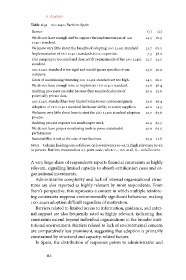
Table 6.31 iso 21401 Barriers: Spain
Barrier () ()
We do not have enough staff to support the implementation of iso . .
standard.
We know very little about the benefits of adopting iso standard. . .
Implementation of iso standards is too expensive. . .
Our company is too small and does not fit requirements of the iso . .
standard.
iso standard is too rigid and would ignore specifics of our . .
company.
Costs of maintaining/renewing iso standard are too high. . .
We do not have enough time to implement iso standard. . .
Auditing processes are risky because they require disclosure of . .
potentially private data.
iso standard has very limited value to our customers/guests. . .
Adoption of iso standard limits our ability to secure suppliers. . .
We know very little about how to start the iso standard adoption . .
process.
Auditing process requires too much paper work. . .
We do not have proper monitoring tools to prove sustainable . .
performance
Sustainability is not at the core of our business . .
Notes Column headings are as follows: (1) low relevance (0–1), (2) high relevance (5–6);
in percent. Barriers measured on a 7-point scale, where 0 – not at all, 6 – to full extent.
A very large share of respondents reports financial constraints as highly
relevant, signalling limited capacity to absorb certification costs and or-
ganisational investments.
Administrative complexity and lack of internal organisational struc-
tures are also reported as highly relevant by most respondents. From
Stern’s perspective, this represents a context in which multiple reinforc-
ing constraints suppress environmentally significant behaviour, making
iso 21401 adoption difficult regardless of motivation.
Barriers related to limited access to information, guidance, and exter-
nal support are also frequently rated as highly relevant, indicating that
constraints extend beyond individual organisations to the broader insti-
tutional environment. Barriers related to lack of environmental concern
are comparatively less prominent, suggesting that adoption is primarily
constrained by structural and capacity-related factors.
In Spain, the distribution of responses points to administrative and
112

