


Page 113 - Sustaining Accommodation SMES
P. 113
6.2 Quantitative Insights
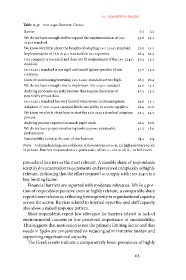
Table 6.32 iso 21401 Barriers: Greece
Barrier () ()
We do not have enough staff to support the implementation of iso . .
standard.
We know very little about the benefits of adopting iso standard. . .
Implementation of iso standards is too expensive. . .
Our company is too small and does not fit requirements of the iso . .
standard.
iso standard is too rigid and would ignore specifics of our . .
company.
Costs of maintaining/renewing iso standard are too high. . .
We do not have enough time to implement iso standard. . .
Auditing processes are risky because they require disclosure of ..
potentially private data.
iso standard has very limited value to our customers/guests. . .
Adoption of iso standard limits our ability to secure suppliers. . .
We know very little about how to start the iso standard adoption . .
process.
Auditing process requires too much paper work. . .
We do not have proper monitoring tools to prove sustainable . .
performance
Sustainability is not at the core of our business ..
Notes Column headings are as follows: (1) low relevance (0–1), (2) high relevance (5–6);
in percent. Barriers measured on a 7-point scale, where 0 – not at all, 6 – to full extent.
procedural barriers as the most relevant. A sizeable share of respondents
identify documentation requirements and perceived complexity as highly
relevant, indicating that the effort required to comply with iso 21401 is a
key limiting factor.
Financial barriers are reported with moderate relevance. While a por-
tion of respondents perceive costs as highly relevant, a comparable share
report lower relevance, reflecting heterogeneity in organisational capacity
across the sector. Barriers related to internal expertise and staff capacity
also show a mixed response pattern.
Most respondents report low relevance for barriers related to lack of
environmental concern or low perceived importance of sustainability.
This suggests that motivation is not the primary limiting factor and that
needs in Spain are concentrated on reducing administrative burden and
supporting organisational capacity.
The Greek results indicate a comparatively lower prevalence of highly
113

