Page 86 - Glasbenopedagoški zbornik Akademije za glasbo v Ljubljani / The Journal of Music Education of the Academy of Music in Ljubljana, leto 7, zvezek 16 / Year 7, Issue 16, 2011
P. 86
SBENO-PEDAGOŠKI ZBORNIK, 16. zvezek
These terms feel right if an inversion of the overtone series is expected. But the
real pitches differ up to a major third.
As Guettler outlined above, the length of the vibrating string is not doubled.
The triggering is much more complex and the paths of triggering waves are
multiple.
With respect to the non-linear system of triggering ALF, further research
would probably lead to other factors, such as strange attractors or corpus
resonance.
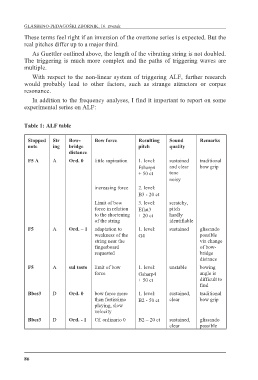
In addition to the frequency analyses, I find it important to report on some
experimental series on ALF:
Table 1: ALF table
Stopped Str Bow- Bow force Resulting Sound Remarks
note ing bridge little supination pitch quality
distance
F5 A A 1. level: sustained traditional
Ord. 0 Fsharp4 and clear bow grip
+ 50 ct tone
2. level: noisy
B3 - 20 ct
increasing force 3. level:
Eflat3
F5 A Ord. – 1 Limit of bow + 20 ct scratchy, glissando
force in relation pitch possible
F5 A to the shortening 1. level: hardly via change
Bbes3 D of the string G4 identifiable of bow-
Bbes3 D sustained bridge
adaptation to 1. level: distance
weakness of the Gsharp4 unstable
string near the + 50 ct bowing
fingerboard sustained, angle is
requested 1. level: clear difficult to
B2 - 50 ct find
sul tasto limit of bow
force B2 – 20 ct traditional
bow grip
Ord. 0 bow force more
Ord. - 1 than fortissimo sustained, glissando
playing, slow
velocity
Cf. ordinario 0
clear possible
86
These terms feel right if an inversion of the overtone series is expected. But the
real pitches differ up to a major third.
As Guettler outlined above, the length of the vibrating string is not doubled.
The triggering is much more complex and the paths of triggering waves are
multiple.
With respect to the non-linear system of triggering ALF, further research
would probably lead to other factors, such as strange attractors or corpus
resonance.
In addition to the frequency analyses, I find it important to report on some
experimental series on ALF:
Table 1: ALF table
Stopped Str Bow- Bow force Resulting Sound Remarks
note ing bridge little supination pitch quality
distance
F5 A A 1. level: sustained traditional
Ord. 0 Fsharp4 and clear bow grip
+ 50 ct tone
2. level: noisy
B3 - 20 ct
increasing force 3. level:
Eflat3
F5 A Ord. – 1 Limit of bow + 20 ct scratchy, glissando
force in relation pitch possible
F5 A to the shortening 1. level: hardly via change
Bbes3 D of the string G4 identifiable of bow-
Bbes3 D sustained bridge
adaptation to 1. level: distance
weakness of the Gsharp4 unstable
string near the + 50 ct bowing
fingerboard sustained, angle is
requested 1. level: clear difficult to
B2 - 50 ct find
sul tasto limit of bow
force B2 – 20 ct traditional
bow grip
Ord. 0 bow force more
Ord. - 1 than fortissimo sustained, glissando
playing, slow
velocity
Cf. ordinario 0
clear possible
86