Page 87 - Glasbenopedagoški zbornik Akademije za glasbo v Ljubljani / The Journal of Music Education of the Academy of Music in Ljubljana, leto 7, zvezek 16 / Year 7, Issue 16, 2011
P. 87
a Biffio, NEW EXTENSIONS OF THE BEAUTIFUL CELLO TONE
Bbes3 D Ord. + 1 increasing bow Bes2 sustained, fist bow
clear grip
force + 20 ct helpful,
C2 C Ord. - 1 high bow Csharp sustained, increasing
bow
pressure, slow 1- 50 ct raucous velocity
possible
fist bow
grip
velocity
Further research on ALF would need to be done with a team of cellist,
composer and acoustician. For example, measuring the bow pressure with a plate
under the bridge would give more precise data which could be tested with
frequency analyses. Nevertheless, the ear and the kinesthetic sense of the
professional musician cannot be replaced.
Multiphonics
With my next point, multiphonics on the cello, we enter the spectrum of high
partials together with a breakable and split cello sound.
Marc Dresser states that “multiphonics are complex sounds generated from a
single source. [...] It is the result of various conflicting messages being sent to the
string at the same time.” (Dresser 2009: 73)
It is important to note that these conflicting messages are coming from the left
hand as well as from the bow. Two or more natural harmonics are triggered to
form a cluster of partials, including or excluding the fundamental.
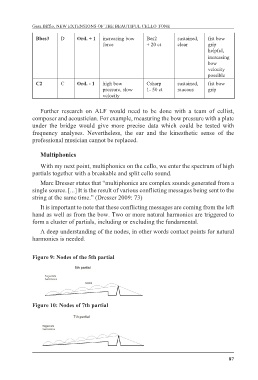
A deep understanding of the nodes, in other words contact points for natural
harmonics is needed.
Figure 9: Nodes of the 5th partial
Figure 10: Nodes of 7th partial
87
Bbes3 D Ord. + 1 increasing bow Bes2 sustained, fist bow
clear grip
force + 20 ct helpful,
C2 C Ord. - 1 high bow Csharp sustained, increasing
bow
pressure, slow 1- 50 ct raucous velocity
possible
fist bow
grip
velocity
Further research on ALF would need to be done with a team of cellist,
composer and acoustician. For example, measuring the bow pressure with a plate
under the bridge would give more precise data which could be tested with
frequency analyses. Nevertheless, the ear and the kinesthetic sense of the
professional musician cannot be replaced.
Multiphonics
With my next point, multiphonics on the cello, we enter the spectrum of high
partials together with a breakable and split cello sound.
Marc Dresser states that “multiphonics are complex sounds generated from a
single source. [...] It is the result of various conflicting messages being sent to the
string at the same time.” (Dresser 2009: 73)
It is important to note that these conflicting messages are coming from the left
hand as well as from the bow. Two or more natural harmonics are triggered to
form a cluster of partials, including or excluding the fundamental.
A deep understanding of the nodes, in other words contact points for natural
harmonics is needed.
Figure 9: Nodes of the 5th partial
Figure 10: Nodes of 7th partial
87