Page 81 - Glasbenopedagoški zbornik Akademije za glasbo v Ljubljani / The Journal of Music Education of the Academy of Music in Ljubljana, leto 7, zvezek 16 / Year 7, Issue 16, 2011
P. 81
a Biffio, NEW EXTENSIONS OF THE BEAUTIFUL CELLO TONE
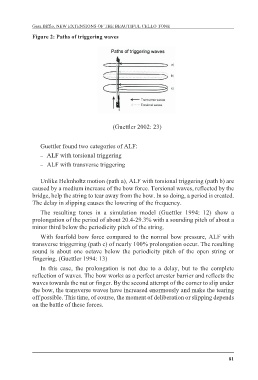
Figure 2: Paths of triggering waves
(Guettler 2002: 23)
Guettler found two categories of ALF:
– ALF with torsional triggering
– ALF with transverse triggering
Unlike Helmholtz motion (path a), ALF with torsional triggering (path b) are
caused by a medium increase of the bow force. Torsional waves, reflected by the
bridge, help the string to tear away from the bow. In so doing, a period is created.
The delay in slipping causes the lowering of the frequency.
The resulting tones in a simulation model (Guettler 1994: 12) show a
prolongation of the period of about 20.4-29.3% with a sounding pitch of about a
minor third below the periodicity pitch of the string.
With fourfold bow force compared to the normal bow pressure, ALF with
transverse triggerring (path c) of nearly 100% prolongation occur. The resulting
sound is about one octave below the periodicity pitch of the open string or
fingering. (Guettler 1994: 13)
In this case, the prolongation is not due to a delay, but to the complete
reflection of waves. The bow works as a perfect arrester barrier and reflects the
waves towards the nut or finger. By the second attempt of the corner to slip under
the bow, the transverse waves have increased enormously and make the tearing
off possible. This time, of course, the moment of deliberation or slipping depends
on the battle of these forces.
81
Figure 2: Paths of triggering waves
(Guettler 2002: 23)
Guettler found two categories of ALF:
– ALF with torsional triggering
– ALF with transverse triggering
Unlike Helmholtz motion (path a), ALF with torsional triggering (path b) are
caused by a medium increase of the bow force. Torsional waves, reflected by the
bridge, help the string to tear away from the bow. In so doing, a period is created.
The delay in slipping causes the lowering of the frequency.
The resulting tones in a simulation model (Guettler 1994: 12) show a
prolongation of the period of about 20.4-29.3% with a sounding pitch of about a
minor third below the periodicity pitch of the string.
With fourfold bow force compared to the normal bow pressure, ALF with
transverse triggerring (path c) of nearly 100% prolongation occur. The resulting
sound is about one octave below the periodicity pitch of the open string or
fingering. (Guettler 1994: 13)
In this case, the prolongation is not due to a delay, but to the complete
reflection of waves. The bow works as a perfect arrester barrier and reflects the
waves towards the nut or finger. By the second attempt of the corner to slip under
the bow, the transverse waves have increased enormously and make the tearing
off possible. This time, of course, the moment of deliberation or slipping depends
on the battle of these forces.
81