Page 90 - Glasbenopedagoški zbornik Akademije za glasbo v Ljubljani / The Journal of Music Education of the Academy of Music in Ljubljana, leto 7, zvezek 16 / Year 7, Issue 16, 2011
P. 90
SBENO-PEDAGOŠKI ZBORNIK, 16. zvezek
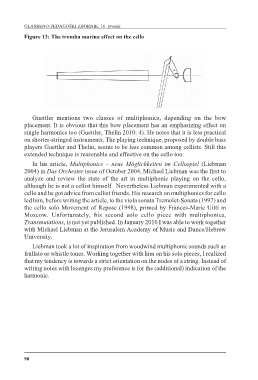
Figure 13: The tromba marina effect on the cello
Guettler mentions two classes of multiphonics, depending on the bow
placement. It is obvious that this bow placement has an emphasizing effect on
single harmonics too (Guettler, Thelin 2010: 4). He notes that it is less practical
on shorter-stringed instruments. The playing technique, proposed by double bass
players Guettler and Thelin, seems to be less common among cellists. Still this
extended technique is reasonable and effective on the cello too.
In his article, Multiphonics – neue Möglichkeiten im Cellospiel (Liebman
2004) in Das Orchester issue of October 2004, Michael Liebman was the first to
analyze and review the state of the art in multiphonic playing on the cello,
although he is not a cellist himself. Nevertheless Liebman experimented with a
cello and he got advice from cellist friends. His research on multiphonics for cello
led him, before writing the article, to the viola sonata Tremolet-Sonata (1997) and
the cello solo Movement of Repose (1998), primed by Frances-Marie Uitti in
Moscow. Unfortunately, his second solo cello piece with multiphonics,
Transmutations, is not yet published. In January 2010 I was able to work together
with Michael Liebman at the Jerusalem Academy of Music and Dance/Hebrew
University.
Liebman took a lot of inspiration from woodwind multiphonic sounds such as
frullato or whistle tones. Working together with him on his solo pieces, I realized
that my tendency is towards a strict orientation on the nodes of a string. Instead of
writing notes with lozenges my preference is for the (additional) indication of the
harmonic.
90
Figure 13: The tromba marina effect on the cello
Guettler mentions two classes of multiphonics, depending on the bow
placement. It is obvious that this bow placement has an emphasizing effect on
single harmonics too (Guettler, Thelin 2010: 4). He notes that it is less practical
on shorter-stringed instruments. The playing technique, proposed by double bass
players Guettler and Thelin, seems to be less common among cellists. Still this
extended technique is reasonable and effective on the cello too.
In his article, Multiphonics – neue Möglichkeiten im Cellospiel (Liebman
2004) in Das Orchester issue of October 2004, Michael Liebman was the first to
analyze and review the state of the art in multiphonic playing on the cello,
although he is not a cellist himself. Nevertheless Liebman experimented with a
cello and he got advice from cellist friends. His research on multiphonics for cello
led him, before writing the article, to the viola sonata Tremolet-Sonata (1997) and
the cello solo Movement of Repose (1998), primed by Frances-Marie Uitti in
Moscow. Unfortunately, his second solo cello piece with multiphonics,
Transmutations, is not yet published. In January 2010 I was able to work together
with Michael Liebman at the Jerusalem Academy of Music and Dance/Hebrew
University.
Liebman took a lot of inspiration from woodwind multiphonic sounds such as
frullato or whistle tones. Working together with him on his solo pieces, I realized
that my tendency is towards a strict orientation on the nodes of a string. Instead of
writing notes with lozenges my preference is for the (additional) indication of the
harmonic.
90