Page 85 - Glasbenopedagoški zbornik Akademije za glasbo v Ljubljani / The Journal of Music Education of the Academy of Music in Ljubljana, leto 7, zvezek 16 / Year 7, Issue 16, 2011
P. 85
a Biffio, NEW EXTENSIONS OF THE BEAUTIFUL CELLO TONE
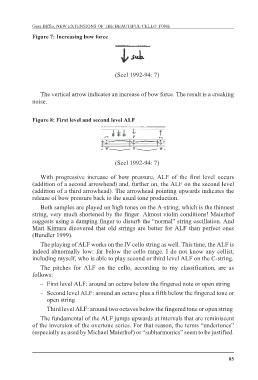
Figure 7: Increasing bow force
(Seel 1992-94: 7)
The vertical arrow indicates an increase of bow force. The result is a creaking
noise.
Figure 8: First level and second level ALF
(Seel 1992-94: 7)
With progressive increase of bow pressure, ALF of the first level occurs
(addition of a second arrowhead) and, further on, the ALF on the second level
(addition of a third arrowhead). The arrowhead pointing upwards indicates the
release of bow pressure back to the usual tone production.
Both samples are played on high tones on the A-string, which is the thinnest
string, very much shortened by the finger. Almost violin conditions! Maierhof
suggests using a damping finger to disturb the “normal” string oscillation. And
Mari Kimura dicovered that old strings are better for ALF than perfect ones
(Bundler 1999).
The playing of ALF works on the IV cello string as well. This time, the ALF is
indeed abnormally low: far below the cello range. I do not know any cellist,
including myself, who is able to play second or third level ALF on the C-string.
The pitches for ALF on the cello, according to my classification, are as
follows:
– First level ALF: around an octave below the fingered note or open string
– Second level ALF: around an octave plus a fifth below the fingered tone or
open string
– Third level ALF: around two octaves below the fingered tone or open string
The fundamental of the ALF jumps upwards at intervals that are reminiscent
of the inversion of the overtone series. For that reason, the terms “undertones”
(especially as used by Michael Maierhof) or “subharmonics” seem to be justified.
85
Figure 7: Increasing bow force
(Seel 1992-94: 7)
The vertical arrow indicates an increase of bow force. The result is a creaking
noise.
Figure 8: First level and second level ALF
(Seel 1992-94: 7)
With progressive increase of bow pressure, ALF of the first level occurs
(addition of a second arrowhead) and, further on, the ALF on the second level
(addition of a third arrowhead). The arrowhead pointing upwards indicates the
release of bow pressure back to the usual tone production.
Both samples are played on high tones on the A-string, which is the thinnest
string, very much shortened by the finger. Almost violin conditions! Maierhof
suggests using a damping finger to disturb the “normal” string oscillation. And
Mari Kimura dicovered that old strings are better for ALF than perfect ones
(Bundler 1999).
The playing of ALF works on the IV cello string as well. This time, the ALF is
indeed abnormally low: far below the cello range. I do not know any cellist,
including myself, who is able to play second or third level ALF on the C-string.
The pitches for ALF on the cello, according to my classification, are as
follows:
– First level ALF: around an octave below the fingered note or open string
– Second level ALF: around an octave plus a fifth below the fingered tone or
open string
– Third level ALF: around two octaves below the fingered tone or open string
The fundamental of the ALF jumps upwards at intervals that are reminiscent
of the inversion of the overtone series. For that reason, the terms “undertones”
(especially as used by Michael Maierhof) or “subharmonics” seem to be justified.
85