Page 88 - Glasbenopedagoški zbornik Akademije za glasbo v Ljubljani / The Journal of Music Education of the Academy of Music in Ljubljana, leto 7, zvezek 16 / Year 7, Issue 16, 2011
P. 88
SBENO-PEDAGOŠKI ZBORNIK, 16. zvezek
As can be seen on the figures, the string naturally vibrates as a whole. At the
same time it vibrates in integer divisions, known as modes. By the time the finger
touches the string on one of the nodes (= points which separate the integer
divisions) it annihilates larger oscillations and triggers the division into certain
partials: the frequency of the harmonic partial will be heard. Since the harmonic
relates to the frequency of an unstopped string, the resulting harmonic is called a
“natural harmonic”, the playing technique used is known as flageolet playing.
When you overlap the nodes of several partials, you will see that in the middle
of the string there must be a natural accumulation of nodes. The longer divisions
are stronger than the shorter ones and with the “fat finger” technique the cellist is
able to cover more than one flageolet point at the same time.
One famous example is the space around the tritone, which is densely
populated with flageolet nodes, among which the 5th and 7th partials are dominant.
Under certain circumstances of bow pressure, the fundamental of the open string
will be added to the chord of partials. Michael Bach points out the occurrence of
strong differential tones, characterizing the sound (Bach 1991: 32).
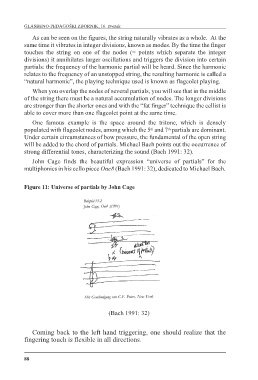
John Cage finds the beautiful expression “universe of partials” for the
multiphonics in his cello piece One8 (Bach 1991: 32), dedicated to Michael Bach.
Figure 11: Universe of partials by John Cage
(Bach 1991: 32)
Coming back to the left hand triggering, one should realize that the
fingering touch is flexible in all directions.
88
As can be seen on the figures, the string naturally vibrates as a whole. At the
same time it vibrates in integer divisions, known as modes. By the time the finger
touches the string on one of the nodes (= points which separate the integer
divisions) it annihilates larger oscillations and triggers the division into certain
partials: the frequency of the harmonic partial will be heard. Since the harmonic
relates to the frequency of an unstopped string, the resulting harmonic is called a
“natural harmonic”, the playing technique used is known as flageolet playing.
When you overlap the nodes of several partials, you will see that in the middle
of the string there must be a natural accumulation of nodes. The longer divisions
are stronger than the shorter ones and with the “fat finger” technique the cellist is
able to cover more than one flageolet point at the same time.
One famous example is the space around the tritone, which is densely
populated with flageolet nodes, among which the 5th and 7th partials are dominant.
Under certain circumstances of bow pressure, the fundamental of the open string
will be added to the chord of partials. Michael Bach points out the occurrence of
strong differential tones, characterizing the sound (Bach 1991: 32).
John Cage finds the beautiful expression “universe of partials” for the
multiphonics in his cello piece One8 (Bach 1991: 32), dedicated to Michael Bach.
Figure 11: Universe of partials by John Cage
(Bach 1991: 32)
Coming back to the left hand triggering, one should realize that the
fingering touch is flexible in all directions.
88