Page 104 - Glasbenopedagoški zbornik Akademije za glasbo v Ljubljani / The Journal of Music Education of the Academy of Music in Ljubljana, leto 7, zvezek 16 / Year 7, Issue 16, 2011
P. 104
SBENO-PEDAGOŠKI ZBORNIK, 16. zvezek
the cello, as he was able to produce them by himself. In a workshop he held at the
Münster Academy in June 2009, I was able to see Lachenmann demonstrate all
the techniques he demanded from the violinist, the cellist and the pianist.
Schmidt-Mechau’s concept is broadly open to all kinds of results with respect
to the sound. Lachenmann notates the action but knows the result, which only
differs marginally from player to player. Schmidt-Mechau, by contrast, opens up
a palette of expressive meanings. Therefore he decided not to give me any
recording of his works. According to him, each performance has a completely
different outcome. He comments: “My expectations are focused on the cellists,
whether and how they grasp, use and control all the ranges of their instrument.”
(Email Schmidt-Mechau 29.9.2009)
The cello player, interpreter and dedicatee Matthias Lorenz describes his work
on Morgenlachen as follows:
“[…] Thereafter three things especially are uncommon:
The orientation alongside the moves instead of sounds: One knows bit by bit
only, how a certain part is supposed to sound, the way there is rather abstract with
respect to the musical-phonetic aspects. Afterwards one can stick to the sound as
usual.
The extension of moves beyond their usual limits: The turn of the bow, for
example, reaches from a 75° down- and upwards rotated tip, the contact point for
stringing in the peg box reaches via the cords up to the endpin.
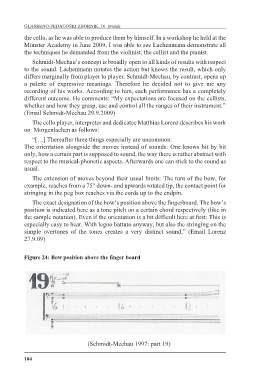
The exact designation of the bow‘s position above the fingerboard. The bow’s
position is indicated here as a tone pitch on a certain chord respectively (like in
the sample notation). Even if the orientation is a bit difficult here at first: This is
especially easy to hear. With legno battuto anyway, but also the stringing on the
simple overtones of the tones creates a very distinct sound.” (Email Lorenz
27.9.09)
Figure 24: Bow position above the finger board
(Schmidt-Mechau 1997: part 19)
104
the cello, as he was able to produce them by himself. In a workshop he held at the
Münster Academy in June 2009, I was able to see Lachenmann demonstrate all
the techniques he demanded from the violinist, the cellist and the pianist.
Schmidt-Mechau’s concept is broadly open to all kinds of results with respect
to the sound. Lachenmann notates the action but knows the result, which only
differs marginally from player to player. Schmidt-Mechau, by contrast, opens up
a palette of expressive meanings. Therefore he decided not to give me any
recording of his works. According to him, each performance has a completely
different outcome. He comments: “My expectations are focused on the cellists,
whether and how they grasp, use and control all the ranges of their instrument.”
(Email Schmidt-Mechau 29.9.2009)
The cello player, interpreter and dedicatee Matthias Lorenz describes his work
on Morgenlachen as follows:
“[…] Thereafter three things especially are uncommon:
The orientation alongside the moves instead of sounds: One knows bit by bit
only, how a certain part is supposed to sound, the way there is rather abstract with
respect to the musical-phonetic aspects. Afterwards one can stick to the sound as
usual.
The extension of moves beyond their usual limits: The turn of the bow, for
example, reaches from a 75° down- and upwards rotated tip, the contact point for
stringing in the peg box reaches via the cords up to the endpin.
The exact designation of the bow‘s position above the fingerboard. The bow’s
position is indicated here as a tone pitch on a certain chord respectively (like in
the sample notation). Even if the orientation is a bit difficult here at first: This is
especially easy to hear. With legno battuto anyway, but also the stringing on the
simple overtones of the tones creates a very distinct sound.” (Email Lorenz
27.9.09)
Figure 24: Bow position above the finger board
(Schmidt-Mechau 1997: part 19)
104