Page 101 - Glasbenopedagoški zbornik Akademije za glasbo v Ljubljani / The Journal of Music Education of the Academy of Music in Ljubljana, leto 7, zvezek 16 / Year 7, Issue 16, 2011
P. 101
a Biffio, NEW EXTENSIONS OF THE BEAUTIFUL CELLO TONE
As described above, in Synchronisation the use of two bows is related to a
dramatic predisposition of the cello’s tuning. Apart from the consequences of the
tonal material, the enormous increase of string tension for the up-tuned strings
and the decrease for the down-tuned strings has an important impact on the
playability and sound quality of the strings.
Hereby, the critical point is in the middle of my scordatura: in order to attain a
major second between the strings II and III, the G-string is heightened to an A2.
The heightening for a major second comes near to the breaking point; whether the
string or the instrument’s body might be affected, depends on their quality and
age.
Scordatura
Through noticeable tuning up, the inner layers of the string construction will be
weakened. The string loses its sound quality for normal playing in standard
tuning as well. For this reason, most cellists prefer using extra strings put on a
second cello, in case the whole setting is provided for scordatura. Obviously the
scordatura implies practical problems.
From the point of view of playability, the differences in tension provoked by
tuning up or down (sometimes on the same instrument), make an adaptation of the
bowing hand necessary.
Since the strings have been constructed for a certain defined pitch, with the
whole set of strings in balance, each change of tension causes a loss of the
playing features. On the other hand, playing on detuned strings with different
modified tension and friction forces gives a fresh sensomotoric stimulus to the
performer.
Creation of a prototype scordatura string
Discussions about the sonority and playability of strings in scordatura led to
Laurits Larsen at Larsen Strings and to the measuring instruments of his company
in Denmark.
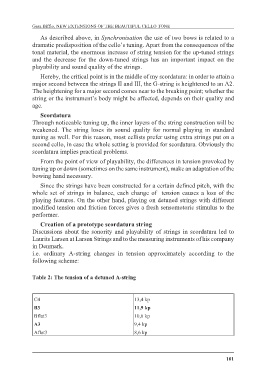
i.e. ordinary A-string changes in tension approximately according to the
following scheme:
Table 2: The tension of a detuned A-string
C4 13,4 kp
B3 11,9 kp
Bflat3 10,6 kp
A3 9,4 kp
Aflat3 8,6 kp
101
As described above, in Synchronisation the use of two bows is related to a
dramatic predisposition of the cello’s tuning. Apart from the consequences of the
tonal material, the enormous increase of string tension for the up-tuned strings
and the decrease for the down-tuned strings has an important impact on the
playability and sound quality of the strings.
Hereby, the critical point is in the middle of my scordatura: in order to attain a
major second between the strings II and III, the G-string is heightened to an A2.
The heightening for a major second comes near to the breaking point; whether the
string or the instrument’s body might be affected, depends on their quality and
age.
Scordatura
Through noticeable tuning up, the inner layers of the string construction will be
weakened. The string loses its sound quality for normal playing in standard
tuning as well. For this reason, most cellists prefer using extra strings put on a
second cello, in case the whole setting is provided for scordatura. Obviously the
scordatura implies practical problems.
From the point of view of playability, the differences in tension provoked by
tuning up or down (sometimes on the same instrument), make an adaptation of the
bowing hand necessary.
Since the strings have been constructed for a certain defined pitch, with the
whole set of strings in balance, each change of tension causes a loss of the
playing features. On the other hand, playing on detuned strings with different
modified tension and friction forces gives a fresh sensomotoric stimulus to the
performer.
Creation of a prototype scordatura string
Discussions about the sonority and playability of strings in scordatura led to
Laurits Larsen at Larsen Strings and to the measuring instruments of his company
in Denmark.
i.e. ordinary A-string changes in tension approximately according to the
following scheme:
Table 2: The tension of a detuned A-string
C4 13,4 kp
B3 11,9 kp
Bflat3 10,6 kp
A3 9,4 kp
Aflat3 8,6 kp
101