Page 99 - Glasbenopedagoški zbornik Akademije za glasbo v Ljubljani / The Journal of Music Education of the Academy of Music in Ljubljana, leto 7, zvezek 16 / Year 7, Issue 16, 2011
P. 99
a Biffio, NEW EXTENSIONS OF THE BEAUTIFUL CELLO TONE
industrial building, the solo cello composition was conceptualised to fill a large
hall with sound and to provide extra visual attraction, responding to the
dimensions and the raw ambience of the building.
The 2Bows/2Hands technique was, in my opinion, the perfect choice for these
skills. In my solo composition, Synchronisation, the alteration of large theatrical
movement and small interference beats corresponds to the scordatura with large
intervals between the outer strings and small intervals between the middle strings.
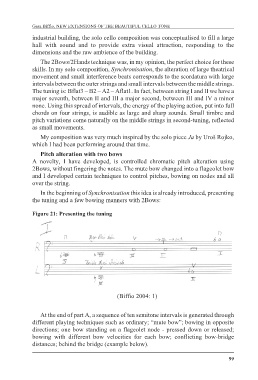
The tuning is: Bflat3 – B2 – A2 – Aflat1. In fact, between string I and II we have a
major seventh, between II and III a major second, between III and IV a minor
none. Using this spread of intervals, the energy of the playing action, put into full
chords on four strings, is audible as large and sharp sounds. Small timbre and
pitch variations come naturally on the middle strings in second-tuning, reflected
as small movements.
My composition was very much inspired by the solo piece Ja by Uroš Rojko,
which I had been performing around that time.
Pitch alteration with two bows
A novelty, I have developed, is controlled chromatic pitch alteration using
2Bows, without fingering the notes. The mute bow changed into a flageolet bow
and I developed certain techniques to control pitches, bowing on nodes and all
over the string.
In the beginning of Synchronisation this idea is already introduced, presenting
the tuning and a few bowing manners with 2Bows:
Figure 21: Presenting the tuning
(Biffio 2004: 1)
At the end of part A, a sequence of ten semitone intervals is generated through
different playing techniques such as ordinary; “mute bow”; bowing in opposite
directions; one bow standing on a flageolet node - pressed down or released;
bowing with different bow velocities for each bow; conflicting bow-bridge
distances; behind the bridge (example below).
99
industrial building, the solo cello composition was conceptualised to fill a large
hall with sound and to provide extra visual attraction, responding to the
dimensions and the raw ambience of the building.
The 2Bows/2Hands technique was, in my opinion, the perfect choice for these
skills. In my solo composition, Synchronisation, the alteration of large theatrical
movement and small interference beats corresponds to the scordatura with large
intervals between the outer strings and small intervals between the middle strings.
The tuning is: Bflat3 – B2 – A2 – Aflat1. In fact, between string I and II we have a
major seventh, between II and III a major second, between III and IV a minor
none. Using this spread of intervals, the energy of the playing action, put into full
chords on four strings, is audible as large and sharp sounds. Small timbre and
pitch variations come naturally on the middle strings in second-tuning, reflected
as small movements.
My composition was very much inspired by the solo piece Ja by Uroš Rojko,
which I had been performing around that time.
Pitch alteration with two bows
A novelty, I have developed, is controlled chromatic pitch alteration using
2Bows, without fingering the notes. The mute bow changed into a flageolet bow
and I developed certain techniques to control pitches, bowing on nodes and all
over the string.
In the beginning of Synchronisation this idea is already introduced, presenting
the tuning and a few bowing manners with 2Bows:
Figure 21: Presenting the tuning
(Biffio 2004: 1)
At the end of part A, a sequence of ten semitone intervals is generated through
different playing techniques such as ordinary; “mute bow”; bowing in opposite
directions; one bow standing on a flageolet node - pressed down or released;
bowing with different bow velocities for each bow; conflicting bow-bridge
distances; behind the bridge (example below).
99