Page 102 - Glasbenopedagoški zbornik Akademije za glasbo v Ljubljani / The Journal of Music Education of the Academy of Music in Ljubljana, leto 7, zvezek 16 / Year 7, Issue 16, 2011
P. 102
SBENO-PEDAGOŠKI ZBORNIK, 16. zvezek
The breakage problem is obvious. For the down-tuned C-string, playability
was the focus. As an experiment, we created a prototype string on Aflat1 and
compared it with the quality characteristics of a C-string, lowered to Aflat1,
which we usually do with scordatura. Larsen manufactured the prototype and we
discussed all the steps of this creative process while I was trying out each
experimental string on my cello. With Larsen’s generous permission, I was able
to use this prototype Aflat1-string in concert for my solo Synchronisation and to
compare it to a down-tuned C-string under concert conditions.
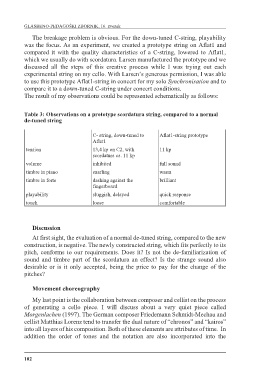
The result of my observations could be represented schematically as follows:
Table 3: Observations on a prototype scordatura string, compared to a normal
de-tuned string
tension C- string, down-tuned to Aflat1-string prototype
Aflat1
volume 11 kp
timbre in piano 13,4 kp on C2, with
timbre in forte scordatura ca. 11 kp full sound
warm
playability inhibited brilliant
touch
snarling quick response
comfortable
dashing against the
fingerboard
sluggish, delayed
loose
Discussion
At first sight, the evaluation of a normal de-tuned string, compared to the new
construction, is negative. The newly constructed string, which fits perfectly to its
pitch, conforms to our requirements. Does it? Is not the de-familiarization of
sound and timbre part of the scordatura an effect? Is the strange sound also
desirable or is it only accepted, being the price to pay for the change of the
pitches?
Movement choreography
My last point is the collaboration between composer and cellist on the process
of generating a cello piece. I will discuss about a very quiet piece called
Morgenlachen (1997). The German composer Friedemann Schmidt-Mechau and
cellist Matthias Lorenz tend to transfer the dual nature of “chronos” and “kairos”
into all layers of his composition. Both of these elements are attributes of time. In
addition the order of tones and the notation are also incorporated into the
102
The breakage problem is obvious. For the down-tuned C-string, playability
was the focus. As an experiment, we created a prototype string on Aflat1 and
compared it with the quality characteristics of a C-string, lowered to Aflat1,
which we usually do with scordatura. Larsen manufactured the prototype and we
discussed all the steps of this creative process while I was trying out each
experimental string on my cello. With Larsen’s generous permission, I was able
to use this prototype Aflat1-string in concert for my solo Synchronisation and to
compare it to a down-tuned C-string under concert conditions.
The result of my observations could be represented schematically as follows:
Table 3: Observations on a prototype scordatura string, compared to a normal
de-tuned string
tension C- string, down-tuned to Aflat1-string prototype
Aflat1
volume 11 kp
timbre in piano 13,4 kp on C2, with
timbre in forte scordatura ca. 11 kp full sound
warm
playability inhibited brilliant
touch
snarling quick response
comfortable
dashing against the
fingerboard
sluggish, delayed
loose
Discussion
At first sight, the evaluation of a normal de-tuned string, compared to the new
construction, is negative. The newly constructed string, which fits perfectly to its
pitch, conforms to our requirements. Does it? Is not the de-familiarization of
sound and timbre part of the scordatura an effect? Is the strange sound also
desirable or is it only accepted, being the price to pay for the change of the
pitches?
Movement choreography
My last point is the collaboration between composer and cellist on the process
of generating a cello piece. I will discuss about a very quiet piece called
Morgenlachen (1997). The German composer Friedemann Schmidt-Mechau and
cellist Matthias Lorenz tend to transfer the dual nature of “chronos” and “kairos”
into all layers of his composition. Both of these elements are attributes of time. In
addition the order of tones and the notation are also incorporated into the
102