


Page 67 - Sustaining Accommodation SMES
P. 67
6.2 Quantitative Insights
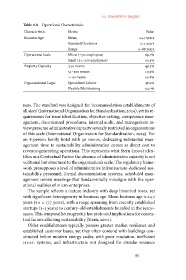
Table 6.8 Operational Characteristics
Characteristic Metric Value
Business Age Mean . years
Standard Deviation . years
Range – years
Operational Scale Micro (≤ employees) .
Small (– employees) .
Property Capacity ≤ rooms .
– rooms .
> rooms .
Organisational Logic Specialised Labour .
Flexible/Multitasking .
ness. The standard was designed for ‘accommodation establishments of
all sizes’ (International Organization for Standardization, 2024), yet its re-
quirements for issue identification, objective-setting, competence man-
agement, documented procedures, internal audit, and management re-
view presume administrative capacity severely restricted in organisations
of this scale (International Organization for Standardization, 2024). For
an 8-person family hotel with 30 rooms, dedicating substantial man-
agement time to sustainability administration comes at direct cost to
revenue-generating operations. This represents what Stern (2000) iden-
tifies as a Contextual Factor: the absence of administrative capacity is not
volitional but structural to the organisation’s scale. The regulatory frame-
work presupposes a level of administrative infrastructure-dedicated sus-
tainability personnel, formal documentation systems, scheduled man-
agement review meetings-that fundamentally misaligns with the oper-
ational realities of micro-enterprises.
The sample reflects a mature industry with deep historical roots, yet
with significant heterogeneity in business age. Mean business age is 24.7
years (sd = 17.7 years), with a range spanning from recently established
startups (1–3 years) to century-old establishments founded in the 1920s–
1930s. This temporal heterogeneity has profound implications for contex-
tual factors affecting sustainability (Stern, 2000).
Older establishments typically possess greater market resilience and
established customer bases, yet they often contend with buildings con-
structed before modern energy codes, with poor insulation, inefficient
hvac systems, and infrastructure not designed for circular resource
67

