


Page 66 - Sustaining Accommodation SMES
P. 66
6Analysis
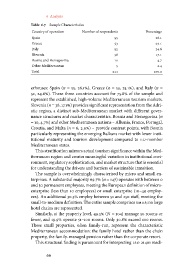
Table 6.7 Sample Characteristics
Country of operation Number of respondents Percentage
Spain .
Greece .
Italy .
Slovenia .
Bosnia and Herzegovina .
Other Mediterranean .
Total .
erhouses: Spain (n = 55, 26.1), Greece (n = 53, 25.1), and Italy (n =
52, 24.6). These three countries account for 75.8 of the sample and
represent the established, high-volume Mediterranean tourism markets.
Slovenia (n = 36, 17.1) provides significant representation from the Adri-
atic region, a distinct sub-Mediterranean market with different gover-
nance structures and market characteristics. Bosnia and Herzegovina (n
= 10, 4.7) and other Mediterranean nations – Albania, France, Portugal,
Croatia, and Malta (n = 6, 2.9) – provide contrast points, with Bosnia
particularly representing the emerging Balkans market with lower insti-
tutional maturity and tourism development compared to eu-member
Mediterranean states.
This stratification mirrors actual tourism significance within the Med-
iterranean region and creates meaningful variation in institutional envi-
ronment, regulatory sophistication, and market structure that is essential
for understanding the drivers and barriers of sustainable transition.
The sample is overwhelmingly characterised by micro and small en-
terprises. A substantial majority 69.7 (n = 147) operates with between 0
and 50 permanent employees, meeting the European definition of micro-
enterprise (less than 10 employees) or small enterprise (10–49 employ-
ees).An additional 30.3employbetween 51 and250 staff,meeting the
small-to-medium definition. The entire sample comprises smes; no large
hotel chains are represented.
Similarly, at the property level, 49.3 (N =104)manage50rooms or
fewer, and 19.9 operate 51–100 rooms. Only 30.8 exceed 100 rooms.
These small properties, often family-run, represent the characteristic
Mediterranean accommodation: the family hotel rather than the chain
property, the family-managed pension rather than the corporate resort.
This structural finding is paramount for interpreting iso 21401 readi-
66

