


Page 85 - Educational Leadership in a Changing World
P. 85
Linking School Principals’ Leadership Styles
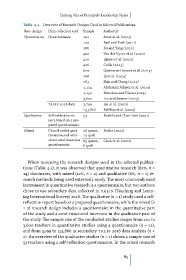
Table 4.3 Overview of Research Designs Used in Selected Publications
Res. design Data collection tool Sample Author(s)
Quantitative Questionnaire Attar et al. ()
Eyal and Roth ()
Xu and Yang ()
Van der Vyver et al. ()
Limon et al. ()
Collie ()
Quinteros-Durand et al. ()
Li et al. ()
Shie and Chang ()
, Abdulaziz Alfayez et al. ()
, Mendoza and Dizon ()
, Lee and Swaner ()
talis data , Liu et al. ()
, Bellibaş et al. ()
Qualitative Self-reflection re- Buskila and Chen-Levi ()
port based on a pre-
pared questionnaire
Mixed Closed-ended ques- quant., Butler ()
tionnaire and semi- qual.
structured interview quant., Cann et al. ()
questionnaire qual.
When reviewing the research designs used in the selected publica-
tions (Table 4.3), it was observed that quantitative research (82, n =
14) dominates, with mixed (12, n = 2) and qualitative (6, n =1)re-
search methods being used extremely rarely. The most commonly used
instrument in quantitative research is a questionnaire, but two authors
chose to use secondary data collected in talis (Teaching and Learn-
ing International Survey) 2018. The qualitative (n = 1) study used a self-
reflection report based on a prepared questionnaire, while the mixed (n
= 2) research design includes a questionnaire in the quantitative part
of the study and a semi-structured interview in the qualitative part of
the study. The sample size of the conducted studies ranges from 101 to
3,600 teachers in quantitative studies using a questionnaire (n = 12),
and from 3,799 to 153,866 in secondary talis 2018 data analysis (n =
2). An overview of the qualitative studies (n =1)shows asample sizeof
53 teachers using a self-reflection questionnaire. In the mixed research
85

