


Page 87 - Educational Leadership in a Changing World
P. 87
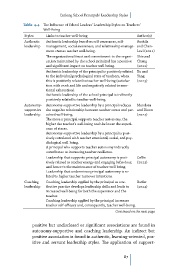
Linking School Principals’ Leadership Styles
Table 4.4 The Influence of School Leaders’ Leadership Styles on Teachers’
Well-Being
Styles Links to teacher well-being Author(s)
Authentic Authentic leadership based on self-awareness, self- Buskila
leadership management, social awareness, and relationship manage- and Chen-
ment creates teacher well-being. Levi ()
The organizational trust and commitment to the organi- Shie and
zation maintained by the school principal has a positive Chang
and significant impact on teacher well-being. ()
Authentic leadership of the principal is positively related Xu and
to the individual psychological state of teachers, when Yang
this is positively related to teacher well-being (satisfac- ()
tion with work and life and negatively related to emo-
tional exhaustion).
Authentic leadership of the school principal is indirectly
positively related to teacher well-being.
Autonomy- Autonomy-supportive leadership by a principal reduces Mendoza
supportive the negative relationship between teacher stress and per- and Dizon
leadership ceived well-being. ()
The more a principal supports teacher autonomy, the
higher the teacher’s well-being and the lower the experi-
ence of stress.
Autonomy-supportive leadership by a principal is posi-
tively correlated with teacher emotional, social, and psy-
chological well-being.
A principal who supports teacher autonomy indirectly
contributes to increasing teacher resilience.
Leadership that supports principal autonomy is posi- Collie
tively related to teacher energy and engaging behaviour, ()
and hence to the maintenance of teacher well-being.
Leadership that undermines principal autonomy is re-
lated to higher teacher turnover intentions.
Coaching Coaching leadership applied by the principal as a re- Butler
leadership flective practice develops leadership skills and leads to ()
increased well-being for both the supervisor and the
teacher.
Coaching leadership applied by the principal increases
teacher self-efficacy and, consequently, teacher well-being.
Continued on the next page
positive but undisclosed or significant associations are found in
autonomy-supportive and coaching leadership. An indirect but
positive association is found in authentic, learning-oriented, pos-
itive and servant leadership styles. The application of support-
87

