


Page 50 - Educational Leadership in a Changing World
P. 50
Rasa Nedzinskait˙ e-Mači¯ unien˙ e and Antonios Kafa
escs
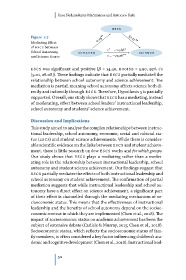
Figure 2.7 0.25** 57.27**
Mediating Effect
of escs between
c =−14.86*
School Autonomy schauto science
and Science Scores c =−29.26**
escs was significant and positive (β = 14.40, bootse = 5.90, 95 ci
[5.01, 28.08]). These findings indicate that escs partially mediated the
relationship between school autonomy and science achievement. The
mediation is partial, meaning school autonomy affects science both di-
rectly and indirectly through escs. Therefore, Hypothesis 5 is partially
supported. Overall, our study shows that escs has a mediating, instead
of moderating, effect between school leaders’ instructional leadership,
school autonomy and students’ science achievement.
Discussion and Implications
This study aimed to analyse the complex relationships between instruc-
tional leadership, school autonomy, economic, social and cultural sta-
tus (escs) and student science achievements. While there is consider-
able scientific evidence on the links between escs and student achieve-
ment, there is little research on how escs works and for which groups.
Our study shows that escs plays a mediating rather than a moder-
ating role in the relationship between instructional leadership, school
autonomy and student science achievement. Our findings suggest that
escs partially mediates the effects of both instructional leadership and
school autonomy on student achievement. The confirmation of partial
mediation suggests that while instructional leadership and school au-
tonomy have a direct effect on science achievement, a significant part
of their effect is channelled through the mediating mechanism of so-
cioeconomic status. This means that the effectiveness of instructional
leadership and the benefits of school autonomy depend on the socioe-
conomic context in which they are implemented (Chen et al., 2018). The
impact of socioeconomic status on academic achievement has been the
subject of extensive debate (Carlisle & Murray, 2015; Chen et al., 2018).
Socioeconomic status, which reflects the socioeconomic status of fam-
ily members, is often considered a key factor influencing children’s aca-
demicandcognitivedevelopment(Chenetal., 2018). Instructional lead-
50

