


Page 47 - Educational Leadership in a Changing World
P. 47
Unearthing Context
Table 2.3 Moderating Effect of escs on the Relation between School Autonomy
and Students’ Science Scores in pisa 2022
Predictors β (se) t () ()
schauto . (.) .* [., .] [., .]
escs . (.) .** [., .] [., .]
Interaction . (.) . [–., .] [–., .]
Conditional Effects of School Autonomy at Different escs Levels
Low (–.) . (.) . [–., .]
Average (.) . (.) .* [., .]
High (.) . (.) .** [., .]
notes 95 confidence interval: (1) low limit, upper limit, (2) boot low limit, boot
2
upper limit. R = 0.56**, F =23.67, N = 60. *Correlation is significant at the 0.05 level
(2-tailed). **Correlation is significant at the 0.01 level (2-tailed).
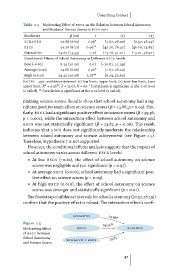
plaining science scores. Results show that school autonomy had a sig-
nificant positive main effect on science scores (β = 14.88, p =0.03).Sim-
ilarly, escs had a significant positive effect on science scores (β = 59.36,
p < 0.001), while the interaction effect between school autonomy and
escs was not statistically significant (β =23.87, p = 0.08). This result
indicates that escs does not significantly moderate the relationship
between school autonomy and science achievement (see Figure 2.5).
Therefore, Hypothesis 7 is not supported.
However, the conditional effects analysis suggests that the impact of
school autonomy varies across different escs levels:
• At low escs (–0.61), the effect of school autonomy on science
scores was negligible and not significant (p = 0.97).
• At average escs (0.000), school autonomy had a significant posi-
tive effect on science scores (p =0.03).
• At high escs (0.610), the effect of school autonomy on science
scores was stronger and statistically significant (p = 0.01).
TheBootstrapconfidenceintervalsforschool autonomy([0.37, 28.19])
confirm that the positive effect is robust. The interaction effect’s confi-
schauto 14.88*
Figure 2.5
59.36**
Moderating Effect escs science
of escs between
School Autonomy 23.87
schauto × escs
and Science Scores
47

