


Page 48 - Educational Leadership in a Changing World
P. 48
Rasa Nedzinskait˙ e-Mači¯ unien˙ e and Antonios Kafa
dence interval ([–3.01, 48.92]) includes zero, reinforcing that the mod-
eration effect is not significant.
Testing for the Mediation Effects
The mediating role of escs in the relationship between instructional
leadership and science scores was investigated. The overall model ex-
2
plains 55 of the variance in science achievement (R = 0.55), with a
significant overall model fit (F (2,57) = 35.36, p < 0.001). As can be seen
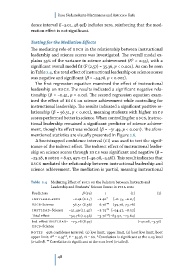
in Table 2.4, the total effect of instructional leadership on science scores
was negative and significant (β =–54.78, p < 0.001).
The first regression equation examined the effect of instructional
leadership on escs. The results indicated a significant negative rela-
tionship (β = –0.41, p = 0.02). The second regression equation exam-
ined the effect of escs on science achievement while controlling for
instructional leadership. The results indicated a significant positive re-
lationship (β = 56.51, p < 0.001), meaning students with higher escs
scores performed better in science. When controlling for escs, instruc-
tional leadership remained a significant predictor of science achieve-
ment, though its effect was reduced (β =–31.49, p < 0.001). The afore-
mentioned statistics are visually presented in Figure 2.6.
A bootstrapped confidence interval (ci) was used to test the signif-
icance of the indirect effect. The indirect effect of instructional leader-
ship on science scores through escs was significant and negative (β =
–23.28, bootse = 8.97, 95 ci [–40.08,–3.56]). This result indicates that
escs mediated the relationship between instructional leadership and
science achievement. The mediation is partial, meaning instructional
Table 2.4 Mediating Effect of escs on the Relation between Instructional
Leadership and Students’ Science Scores in pisa 2022
Predictors β (se) t () ()
instlead–escs –. (.) –.* [–., –.]
escs–Science . (.) .** [., .]
instlead–Science –. (.) –.** [–., –.]
Total effect –. (.) –.**[–., –.]
Ind. effect instlead– –. (.) [–., –.]
escs–Science
notes 95 confidence interval: (1) low limit, upper limit, (2) boot low limit, boot
2
upper limit. R = 0.55**, F = 35.36, N = 60. *Correlation is significant at the 0.05 level
(2-tailed). **Correlation is significant at the 0.01 level (2-tailed).
48

