


Page 70 - Safe Wrestling
P. 70
Marina Dobnik

                  Haddon’s matrix is a useful tool for considering possible strategies, but
                it does not itself provide a clear action plan for progressing from ‘analy-
                sis’ to ‘intervention in practice.’ Conversely, the public health model of-
                ten lacks specific tools for examining injury mechanisms and identifying
                potential points of intervention.
                  In the field of sports injuries, models have therefore been developed
                that combine the strengths of both approaches.

                Van Mechelen’s Sequence of Injury Prevention
                A classic and foundational model in the field of sports injuries is Van
                Mechelen’s model (van Mechelen et al., 1992), which represents the first
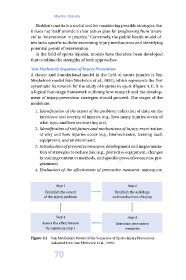
                systematic framework for the study of injuries in sport (Figure 4.1). It is
                a logical four-stage framework outlining how research and the develop-
                ment of injury-prevention strategies should proceed. The stages of the
                model are:
                  1. Identification of the extent of the problem: collection of data on the
                    incidence and severity of injuries (e.g., how many injuries occur, of
                    what type, and how serious they are).
                  2. Identification of risk factors and mechanisms of injury: examination
                    of why and how injuries occur (e.g., biomechanics, training load,
                    equipment, and environment).
                  3. Introduction of preventive measures: development and implementa-
                    tion of strategies to reduce risk (e.g., protective equipment, changes
                    in training content or methods, and specific preventive exercise pro-
                    grammes).
                  4. Evaluation of the effectiveness of preventive measures: assessment


                            Step 1                            Step 2
                       Establish the extent            Establish the aetiology
                      of the injury problem            and mechanism of injury


                            Step 4                            Step 3
                     Assess the effectiveness           Introduce preventive
                       by repeating step 1                  measures

                Figure 4.1 Van Mechelen’s Model of the Sequence of Sports Injury Prevention
                         (adapted from van Mechelen et al., 1992)
                           70

