


Page 69 - Safe Wrestling
P. 69
Models of Injury Occurrence, Prevention and Prediction

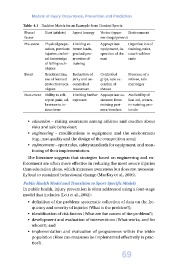
            Table 4.1 Haddon Matrix for an Example from Combat Sports
             Phase/   Host (athlete)  Agent (energy  Vector (oppo-  Environment
             factor                              nent/equipment)
             Pre-event  Physical prepa-  Limiting ex-  Appropriate  Organisation of
                      ration, previous treme loads,  equipment, in-  training, rules,
                      injuries, techni- gradual pro-  spection of the  coach-athlete
                      cal knowledge  gression of  mat         ratio
                      of falling tech-  training
                      niques
             Event    Reaction time,  Reduction of  Controlled  Presence of a
                      use of learned  jerky and un-  grips, safe ex-  referee, safe
                      protective tech- controlled  ecution of  mat edges
                      niques        movement     throws
             Post-event  Ability to self-  Limiting further Appropriate as- Availability of
                      report pain, ad- exposure  sistance from  first aid, return-
                      herence to in-             training part-  to-training pro-
                      structions                 ners/coaches  tocols

              • education – raising awareness among athletes and coaches about
                risks and safe behaviour;
              • engineering – modifications to equipment and the environment
                (e.g., mat quality and the design of the competition area);
              • enforcement – sport rules, safety standards for equipment, and mon-
                itoring of their implementation.
              The literature suggests that strategies based on engineering and en-
            forcement are often more effective in reducing the most severe injuries
            than education alone, which increases awareness but does not necessar-
            ily lead to sustained behavioural change (MacKay et al., 2006).

            Public Health Model and Transition to Sport-Specific Models
            In public health, injury prevention is often addressed using a four-stage
            model that includes (Lett et al., 2002):
              • definition of the problem: systematic collection of data on the fre-
                quency and severity of injuries (What is the problem?);
              • identification of risk factors (What are the causes of the problem?);
              • development and evaluation of interventions (What works, and for
                whom?); and
              • implementation and evaluation of programmes within the wider
                population (How can measures be implemented effectively in prac-
                tice?).

                                                           69

