


Page 110 - Razvoj kompetenc prihodnosti v pedagoških študijskih programih
P. 110
AndrejaŠpernjak inNikaŽidan
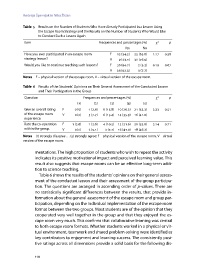
Table 5 Results on the Number of Students Who Have Already Participated in a Lesson Using
the Escape Room Strategy and the Results on the Number of Students Who Would Like
to Conduct Such a Lesson Again
Item Frequences and percentages () χ 2 p
Yes No
Have you ever participated in an escape room F (.) (.) . .
strategy lesson? V (.) (.)
Would you like to continue teaching such lessons? F (.) (.) . .
V (.) (.)
Notes F – physical version of the escape room, V – virtual version of the escape room.
Table 6 Results of the Students’ Opinions on Their General Assessment of the Conducted Lesson
and Their Participation in the Group
Question Frequences and percentages () χ 2 p
() () () () ()
Give an overall rating F () (.) (.) (.) (.) . .
of the escape room V () (.) (.) (.) (.)
experience.
Rate the co-operation F (.) (.) (.) (.) (.) . .
within the group. V () (.) (.) (.) (.)
Notes (1) strongly disagree ... (5) strongly agree; F – physical version of the escape room, V – virtual
version of the escape room.
mentations. The high proportion of students who wish to repeat the activity
indicates its positive motivational impact and perceived learning value. This
result also suggests that escape rooms can be an effective long-term addi-
tion to science teaching.
Table 6 shows the results of the students’ opinions on their general assess-
ment of the conducted lesson and their assessment of the group participa-
tion. The questions are arranged in ascending order of p-values. There are
no statistically significant differences between the results, that provide in-
formation about the general assessment of the escape room and group par-
ticipation, depending on the individual implementation of the escape room
format between the two groups. Most students are of the opinion that they
cooperated very well together in the group and that they enjoyed the es-
cape room very much. This confirms that collaborative learning was central
to both escape room formats. Whether students worked in a physical or vir-
tual environment, teamwork and shared problem-solving were identified as
key contributors to enjoyment and learning success. The consistently posi-
tive ratings across all dimensions provide a solid basis for the following dis-
110

