


Page 106 - Razvoj kompetenc prihodnosti v pedagoških študijskih programih
P. 106
AndrejaŠpernjak inNikaŽidan
ulated similar tasks. Both versions shared identical storylines and cognitive
challenges. After completing the activity, students completed the question-
naire in class under teacher supervision. Teachers were invited to share their
qualitative observations via a short feedback form.
Data Analysis
Data was analyzed using IBM SPSS Statistics 29. Descriptive statistics (fre-
quencies, percentages, and mean values) were calculated to summarize stu-
dents’ responses. Chi-square tests were conducted to identify statistically
significant differences between the two groups (p <0.05).Open-endedre-
sponses were analyzed qualitatively to identify recurring themes related to
motivation and teamwork. Teachers’ feedback was used to triangulate quan-
titative findings and provide contextual interpretation.
Results
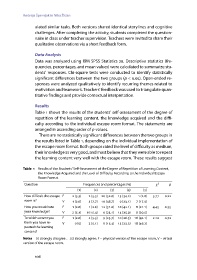
Table 1 shows the results of the students’ self-assessment of the degree of
repetition of the learning content, the knowledge acquired and the diffi-
culty according to the individual escape room format. The statements are
arranged in ascending order of p-values.
There are no statistically significant differences between the two groups in
the results listed in Table 1, depending on the individual implementation of
the escape room format. Both groups rated the level of difficulty as medium,
theirknowledgeasverygood,andmost believethat theywereableto repeat
the learning content very well with the escape room. These results suggest
Table 1 Results of the Students’ Self-Assessment of the Degree of Repetition of Learning Content,
the Knowledge Acquired and the Level of Difficulty According to the Individual Escape
Room Format
Question Frequences and percentages () χ 2 p
() () () () ()
How difficult the escape F (.) (.) (.) (.) (.) . .
room is? V (.) (.) (.) (.) (.)
How you would rate F (.) (.) (.) (.) (.) . .
your knowledge? V (.) (.) (.) (.) (.)
To which extent you F (.) (.) (.) (.) (.) . .
think you have re- V () (.) (.) (.) (.)
peated the learning
content?
Notes (1) strongly disagree ... (5) strongly agree; F – physical version of the escape room, V – virtual
version of the escape room.
106

