


Page 109 - Razvoj kompetenc prihodnosti v pedagoških študijskih programih
P. 109
Escape Rooms as an Active Learning Didactic Strategy
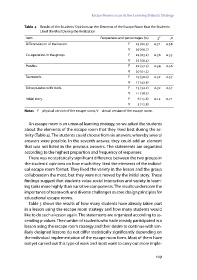
Table 4 Results of the Students’ Opinions on the Elements of the Escape Room that the Students
Liked the Most During the Realization
Item Frequences and percentages () χ 2 p
Differentiation of the lesson. F (.) . .
V (.)
Co-operation in the group. F (.) . .
V (.)
Puzzles. F (.) . .
V (.)
Teamwork. F (.) . .
V (.)
Solve puzzles with tools. F (.) . .
V (.)
Initial story. F (.) . .
V (.)
Notes F – physical version of the escape room, V – virtual version of the escape room.
An escape room is an unusual learning strategy, so we asked the students
about the elements of the escape room that they liked best during the ac-
tivity (Table 4). The students could choose from six answers, whereby several
answers were possible. In the seventh answer, they could add an element
that was not listed in the previous answers. The statements are organized
according to the highest proportion and frequency of responses.
There was no statistically significant difference between the two groups in
the students’ opinions on how much they liked the elements of the individ-
ual escape room format. They liked the variety in the lesson and the group
collaboration the most, but they were not moved by the initial story. These
findings suggest that students value social interaction and variety in learn-
ing tasks more highly than narrative components. The results underscore the
importance of teamwork and diverse challenges as core design principles for
educational escape rooms.
Table 5 shows the results of how many students have already taken part
in a lesson using the escape room strategy and how many students would
like to do such a lesson again. The statements are organized according to as-
cendingp-values.Thenumberofstudentswhohadealreadyparticipatedina
lesson using the escape room strategy and their desire to continue with sim-
ilarly designed lessons do not differ statistically significantly depending on
the individual implementation of the escape room form. Most of them have
not yet carried out this type of work and most want to carry out more imple-
109

