


Page 108 - Razvoj kompetenc prihodnosti v pedagoških študijskih programih
P. 108
AndrejaŠpernjak inNikaŽidan
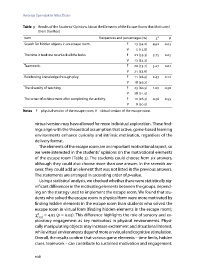
Table 3 Results of the Students’ Opinions About the Elements of the Escape Room that Motivated
them the Most
Item Frequences and percentages () χ 2 p
Search for hidden objects in an escape room. F (.) . .
V (.)
The time it took me to unlock all the locks. F (.) . .
V (.)
Teamwork. F (.) . .
V (.)
Reinforcing knowledge through play. F (.) . .
V (.)
The diversity of teaching. F (.) . .
V (.)
The sense of achievement after completing the activity. F (.) . .
V (.)
Notes F – physical version of the escape room, V – virtual version of the escape room.
virtual version may have allowed for more individual exploration. These find-
ings align with the theoretical assumption that active, game-based learning
environments enhance curiosity and intrinsic motivation, regardless of the
delivery format.
The elements of the escape room are an important motivational aspect, so
we were interested in the students’ opinions on the motivational elements
of the escape room (Table 3). The students could choose from six answers,
although they could also choose more than one answer. In the seventh an-
swer, they could add an element that was not listed in the previous answers.
The statements are arranged in ascending order of p-value.
Using a statistical analysis, we checked whether there were statistically sig-
nificantdifferencesinthemotivatingelementsbetweenthegroups,depend-
ing on the strategy used to implement the escape room. We found that stu-
dents who solved the escape room in physical form were more motivated by
finding hidden elements in the escape room than students who solved the
escape room in virtual form (finding hidden elements in the escape room);
χ 2 =4.92 (p = 0.03). This difference highlights the role of sensory and ex-
(1,5)
ploratory engagement as key motivators in physical environments. Physi-
cally manipulating objects may increase excitement and situational interest,
whilevirtualenvironmentsdependmoreonvisualandcognitivestimulation.
Overall, the results confirm that various game elements – time limits, hidden
clues, teamwork – can contribute to sustained motivation and engagement.
108

