


Page 93 - Sustaining Accommodation SMES
P. 93
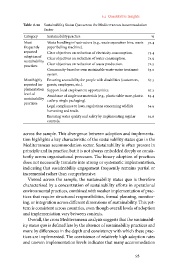
6.2 Quantitative Insights
Table 6.20 Sustainability Status Quo across the Mediterranean Accommodation
Sector
Category Sustainability practice
Most Waste handling infrastructure (e.g., waste separation bins, waste .
frequently paper balling machine).
reported Clear objectives on reduction of electricity consumption. .
adoption of
Clear objectives on reduction of water consumption. .
sustainability
practices Clear objectives on reduction of waste production. .
Community-based or own sustainable waste water treatment .
system.
Most highly Ensuring accessibility for people with disabilities (customers, .
reported im- guests, employees, etc.).
plementation Support local employment opportunities. .
level of
Avoidance of single use materials (e.g., plastic table ware, plastic .
sustainability
cutlery, single packaging).
practices
Legal compliance to laws, regulations concerning wildlife .
harvesting and trade.
Ensuring water quality and safety by implementing regular .
controls.
across the sample. This divergence between adoption and implementa-
tion highlights a key characteristic of the sustainability status quo in the
Mediterranean accommodation sector. Sustainability is often present in
principle and in practice, but it is not always embedded deeply or consis-
tently across organisational processes. The binary adoption of practices
does not necessarily translate into strong or systematic implementation,
indicating that sustainability engagement frequently remains partial or
incremental rather than comprehensive.
Viewed across the sample, the sustainability status quo is therefore
characterised by a concentration of sustainability efforts in operational
environmental practices, combined with weaker implementation of prac-
tices that require structured responsibilities, formal planning, monitor-
ing, or integration across different dimensions of sustainability. This pat-
tern is consistent across countries, even though overall levels of adoption
and implementation vary between contexts.
Overall, the cross Mediterranean analysis suggests that the sustainabil-
ity status quo is defined less by the absence of sustainability practices and
more by differences in the depth and consistency with which these prac-
tices are implemented. The coexistence of relatively high adoption rates
and uneven implementation levels indicates that many accommodation
93

