


Page 419 - Vseživljenjsko učenje kot temelj trajnostne družbe
P. 419
Predictors of Preschool Teachers’ Environmental Activities in Kindergarten
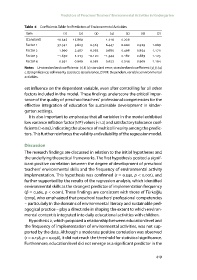
Table 6 Coefficients Table for Predictors of Environmental Activities
Item () () () () () () ()
(Constant) . . . .
Factor . . . . . . .
Factor . . . . . . .
Factor –. . –. –. . . .
Factor . . . . . . .
Notes Unstandardized coefficients: (1) B, (2) standard error; standardized coefficient: (3) β;(4)
t, (5) significance; collinearity statistics: (6) tolerance, (7) VIF. Dependent variable: environmental
activities.
est influence on the dependent variable, even after controlling for all other
factors included in the model. These findings underscore the critical impor-
tance of the quality of preschool teachers’ professional competencies for the
effective integration of education for sustainable development in kinder-
garten settings.
It is also important to emphasize that all variables in the model exhibited
lowvarianceinflationfactor(VIF)values(<1.2)andsatisfactorytolerancecoef-
ficients(>0.85),indicatingtheabsenceofmulticollinearityamongthepredic-
tors.Thisfurtherreinforcesthevalidityandreliabilityoftheregressionmodel.
Discussion
The research findings are discussed in relation to the initial hypotheses and
the underlying theoretical frameworks. The first hypothesis posited a signif-
icant positive correlation between the degree of development of preschool
teachers’ environmental skills and the frequency of environmental activity
implementation. This hypothesis was confirmed (r =0.540, p < 0.001), and
further supported by the results of the regression analysis, which identified
environmental skills as the strongest predictor of implementation frequency
(β =0.565, p < 0.001). These findings are consistent with those of Türkoğlu
(2019), who emphasized that preschool teachers’ professional competencies
– particularly in the domains of environmental literacy and sustainable ped-
agogical practice – play a direct role in shaping the extent to which environ-
mental content is integrated into daily educational activities with children.
Hypothesis 2, which proposed a relationship between education level and
the frequency of implementation of environmental activities, was not sup-
ported by the data. Although a moderate positive correlation was observed
(r =0.158, p = 0.058), it did not reach the threshold for statistical significance.
Furthermore, education level did not emerge as a significant predictor in the
419

