


Page 418 - Vseživljenjsko učenje kot temelj trajnostne družbe
P. 418
Marina Semiz
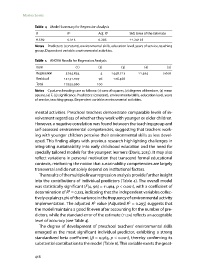
Table 4 Model Summary for Regression Analysis
R R 2 Adj. R 2 Std. Error of the Estimate
. . . .
Notes Predictors: (constant), environmental skills, education level, years of service, teaching
group. Dependent variable: environmental activities.
Table 5 ANOVA Results for Regression Analysis
Item () () () () ()
Regression . . . .
Residual . .
Total .
Notes Cpulumn headings are as follows: (1) sum of squares, (2) degrees of freedom, (3) mean
square, (4) F, (5) significance. Predictors: (constant), environmental skills, education level, years
of service, teaching group. Dependent variable: environmental activities.
mental activities. Preschool teachers demonstrate comparable levels of in-
volvement regardless of whether they work with younger or older children.
However, a negative correlation was found between the teaching group and
self-assessed environmental competencies, suggesting that teachers work-
ing with younger children perceive their environmental skills as less devel-
oped. This finding aligns with previous research highlighting challenges in
integrating sustainability into early childhood education and the need for
specially tailored models for the youngest learners (Davis, 2015). It may also
reflect variations in personal motivation that transcend formal educational
contexts, reinforcing the notion that sustainability competencies are largely
transversal and do not solely depend on institutional factors.
The results of the multiple linear regression analysis provide further insight
into the contributions of individual predictors (Table 4). The overall model
was statistically significant (F(4, 96) = 11.464, p < 0.001), with a coefficient of
2
determination of R = 0.313, indicating that the independent variables collec-
tively explain 31.3 of the variance in the frequency of environmental activity
2
2
implementation. The adjusted R value (Adjusted R = 0.295) suggests that
the model maintains a good fit even after accounting for the number of pre-
dictors, while the standard error of the estimate (11.24) reflects an acceptable
level of accuracy (see Table 4).
The degree of development of preschool teachers’ environmental skills
emerged as the most significant individual predictor, exhibiting a strong
standardized beta coefficient (β =0.565, p < 0.001), thereby confirming its
substantial contribution to the model (Table 6). This variable exerts the great-
418

