Page 79 - Glasbenopedagoški zbornik Akademije za glasbo v Ljubljani / The Journal of Music Education of the Academy of Music in Ljubljana, leto 7, zvezek 16 / Year 7, Issue 16, 2011
P. 79
a Biffio, NEW EXTENSIONS OF THE BEAUTIFUL CELLO TONE
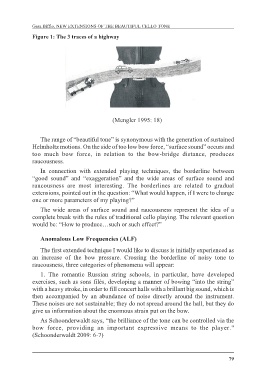
Figure 1: The 3 traces of a highway
(Mengler 1995: 18)
The range of “beautiful tone” is synonymous with the generation of sustained
Helmholtz motions. On the side of too low bow force, “surface sound” occurs and
too much bow force, in relation to the bow-bridge distance, produces
raucousness.
In connection with extended playing techniques, the borderline between
“good sound” and “exaggeration” and the wide areas of surface sound and
raucousness are most interesting. The borderlines are related to gradual
extensions, pointed out in the question: “What would happen, if I were to change
one or more parameters of my playing?”
The wide areas of surface sound and raucousness represent the idea of a
complete break with the rules of traditional cello playing. The relevant question
would be: “How to produce…such or such effect?”
Anomalous Low Frequencies (ALF)
The first extended technique I would like to discuss is initially experienced as
an increase of the bow pressure. Crossing the borderline of noisy tone to
raucousness, three categories of phenomena will appear:
1. The romantic Russian string schools, in particular, have developed
exercises, such as sons filés, developing a manner of bowing “into the string”
with a heavy stroke, in order to fill concert halls with a brillant big sound, which is
then accompanied by an abundance of noise directly around the instrument.
These noises are not sustainable; they do not spread around the hall, but they do
give us information about the enormous strain put on the bow.
As Schoonderwaldt says, “the brilliance of the tone can be controlled via the
bow force, providing an important expressive means to the player."
(Schoonderwaldt 2009: 6-7)
79
Figure 1: The 3 traces of a highway
(Mengler 1995: 18)
The range of “beautiful tone” is synonymous with the generation of sustained
Helmholtz motions. On the side of too low bow force, “surface sound” occurs and
too much bow force, in relation to the bow-bridge distance, produces
raucousness.
In connection with extended playing techniques, the borderline between
“good sound” and “exaggeration” and the wide areas of surface sound and
raucousness are most interesting. The borderlines are related to gradual
extensions, pointed out in the question: “What would happen, if I were to change
one or more parameters of my playing?”
The wide areas of surface sound and raucousness represent the idea of a
complete break with the rules of traditional cello playing. The relevant question
would be: “How to produce…such or such effect?”
Anomalous Low Frequencies (ALF)
The first extended technique I would like to discuss is initially experienced as
an increase of the bow pressure. Crossing the borderline of noisy tone to
raucousness, three categories of phenomena will appear:
1. The romantic Russian string schools, in particular, have developed
exercises, such as sons filés, developing a manner of bowing “into the string”
with a heavy stroke, in order to fill concert halls with a brillant big sound, which is
then accompanied by an abundance of noise directly around the instrument.
These noises are not sustainable; they do not spread around the hall, but they do
give us information about the enormous strain put on the bow.
As Schoonderwaldt says, “the brilliance of the tone can be controlled via the
bow force, providing an important expressive means to the player."
(Schoonderwaldt 2009: 6-7)
79