


Page 170 - Vseživljenjsko učenje kot temelj trajnostne družbe
P. 170
Maja Lebeničnik and Karmen Drljić
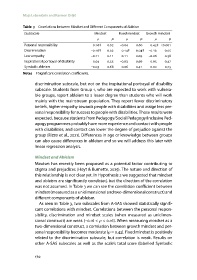
Table 3 Correlations between Mindset and Different Components of Ableism
(Sub)scale Mindset Fixed mindset Growth mindset
ρ p ρ p ρ p
Personal responsibility .‡ . –. . .‡ <.
Discrimination –.‡ . .‡ .‡ –. .
Low empathy –. . . . –. .
Inspirational portrayal of disability . . –. . . .
Symbolic ableism –. . . . . .
Notes ‡Significant correlation coefficients.
discrimination subscale, but not on the inspirational portrayal of disability
subscale. Students from Group 1, who are expected to work with vulnera-
ble groups, report ableism to a lesser degree than students who will work
mainly with the mainstream population. They report fewer discriminatory
beliefs, higher empathy towards people with disabilities and assign less per-
sonal responsibility for success to people with disabilities. Those results were
expected, because students from Pedagogy/Social Pedagogy/Inclusive Ped-
agogyprogrammesprobablyhavemoreexperienceandcontactwithpeople
with disabilities, and contact can lower the degree of prejudice against the
group (Rizzo et al., 2021). Differences in age or knowledge between groups
can also cause differences in ableism and so we will address this later with
linear regression analysis.
Mindset and Ableism
Mindset has recently been proposed as a potential factor contributing to
stigma and prejudices (Hoyt & Burnette, 2025). The nature and direction of
this relationship is not clear yet. In Hypothesis 2 we suggested that mindset
and ableism are significantly correlated, but the direction of the correlation
was not assumed. In Table 3 we can see the correlation coefficient between
mindset(measuredasaunidimensionalandtwo-dimensionalconstruct)and
different components of ableism.
As seen in Table 3, two subscales from A-SAS showed statistically signifi-
cant correlations with mindset. Correlations between the personal respon-
sibility, discrimination and mindset scales (when measured as unidimen-
sional construct) are weak (–0.16 < ρ < 0.16). When measuring mindset as a
two-dimensional construct, a correlation between growth mindset and per-
sonal responsibility becomes moderate (ρ = 0.42). Fixed mindset is positively
related to the discrimination subscale, but correlation is weak. Results on
other A-SAS subscales as well as the scale’s total score (labelled Symbolic
170

