


Page 163 - Vseživljenjsko učenje kot temelj trajnostne družbe
P. 163
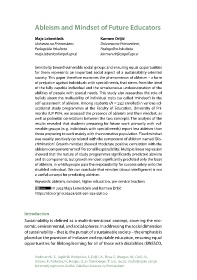
Ableism and Mindset of Future Educators


                  Maja Lebeničnik                Karmen Drljić
                  Univerza na Primorskem,        Univerza na Primorskem,
                  Pedagoška fakulteta            Pedagoška fakulteta
                  maja.lebenicnik@pef.upr.si     karmen.drljic@pef.upr.si


                  Sensitivity toward vulnerable social groups and ensuring equal opportunities
                  for them represents an important social aspect of a sustainability-oriented
                  society. This paper therefore examines the phenomenon of ableism – a form
                  of prejudice against individuals with special needs, that stems from the ideal
                  of the fully capable individual and the simultaneous underestimation of the
                  abilities of people with special needs. This study also researches the role of
                  beliefs about the malleability of individual traits (so called ‘mindset’) in the
                  self-assessment of ableism. Among students (N = 232) enrolled in various ed-
                  ucational study programmes at the Faculty of Education, University of Pri-
                  morska (UP PEF), we assessed the presence of ableism and their mindset, as
                  well as potential correlations between the two concepts. The analysis of the
                  results revealed that students preparing for future work primarily with vul-
                  nerable groups (e.g. individuals with special needs) report less ableism than
                  those preparing to work mainly with the normative population. Fixed mindset
                  was weakly positively correlated with the component of ableism named ‘Dis-
                  crimination.’ Growth mindset showed moderate positive correlation with the
                  ableismcomponentnamed‘PersonalResponsibility.’Multiplelinearregression
                  showed that the nature of study programmes significantly predicted ableism
                  and its components, but growth mindset significantly predicted only the facet
                  of ableism, in which people pass the responsibility for success solely onto the
                  disabled individual. We can conclude that mindset (about intelligence) is not
                  a useful concept for predicting ableism.
                  Keywords: ableism, mindset, higher education, pre-service teachers
                          © 2025 Maja Lebeničnik and Karmen Drljić
                  https://doi.org/10.26493/978-961-293-538-2.9


             Introduction
             Sustainability is defined as a multi-dimensional concept, covering the eco-
             nomic,environmental,andsocialspheres.In addressingthesocialdimension
             of sustainability – that is, the pursuit of a sustainable society – the emphasis is
             placed on the provision of inclusive and equitable education, ensuring equal
             opportunities for lifelong learning for all of those with disabilities (UNESCO,


                  Hudovernik, S., Lepičnik Vodopivec, J., Drljić, K., Birsa, E., Mezgec, M., Cotič, N.,
                  Dolenc, P., Ferbežar, N., Hozjan, D., in Štemberger, T. (ur.). (2025). Vseživljenjsko učenje
                  kot temelj trajnostne družbe. Založba Univerze na Primorskem.

