


Page 130 - Vseživljenjsko učenje kot temelj trajnostne družbe
P. 130
Vita Jeraj and Petra Dolenc
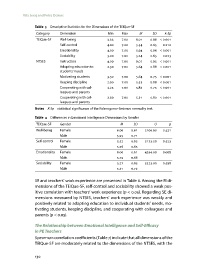
Table 3 Descriptive Statistics for the Dimensions of the TEIQue-SF
Category Dimension Min Max M SD K-Sp
TEIQue-SF Well-being . . . . < .
Self-control . . . . .
Emotionality . . . . < .
Sociability . . . . .
NTSES Instruction . . . . < .
Adapting education to . . . . < .
students’ needs
Motivating students . . . . < .
Keeping discipline . . . . < .
Cooperating with col- . . . . < .
leagues and parents
Cooperating with col- . . . , < .
leagues and parents
Notes K-Sp – statistical significance of the Kolmogorov-Smirnov normality test.
Table 4 Differences in Emotional Intelligence Dimensions by Gender
TEIQue-SF Gender M SD U p
Well-being Female . . . .
Male . .
Self-control Female . . . .
Male . .
Emotionality Female . . . .
Male . .
Sociability Female . . . .
Male . .
SE and teachers’ work experience are presented in Table 6. Among the EI di-
mensions of the TEIQue-SF, self-control and sociability showed a weak pos-
itive correlation with teachers’ work experience (p < 0.05). Regarding SE di-
mensions measured by NTSES, teachers’ work experience was weakly and
positively related to adapting education to individual students’ needs, mo-
tivating students, keeping discipline, and cooperating with colleagues and
parents (p <0.05).
The Relationship between Emotional Intelligence and Self-Efficacy
in PE Teachers
Spearman correlation coefficients (Table 7) indicate that all dimensions of the
TEIQue-SF are moderately related to the dimensions of the NTSES, with the
130

