


Page 27 - Diversity in Action
P. 27
Developing Linguistic and Cultural Awareness at an Early Age


             ing between individuals who lack a common language. In situations without
             a mediator, people may still achieve some level of understanding by using
             their entire linguistic repertoire, experimenting with expressions across lan-
             guages or dialects, relying on paralinguistic tools like gestures and facial ex-
             pressions, or significantly simplifying their language use.
               The scope of the plurilingual concept thus presupposes a communica-
             tive competence that encompasses the entire knowledge of and experience
             with languages as they interact and influence each other. Therefore, plurilin-
             gualism is above all a prerequisite for successful communication with people
             from other cultural and linguistic backgrounds.
               An important aspect of plurilingual education is that it does not just focus
             on developing the linguistic resources and linguistic potential of learners but
             is also directly related to the acceptance of other people’s languages and to
             a sense of curiosity about these languages (Beacco & Byram, 2007). In fact,
             developing positive attitudes or curiosity towards other languages and cul-
             tures should be a basic component of all language teaching. This also implies
             the inclusion of the learners’ mother tongue or first language, which is not
             necessarily the language of instruction or the official language of the envi-
             ronment.
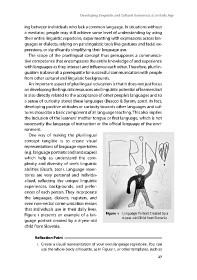
               One way of making the plurilingual
             concepttangibleistocreatevisual
             representations of language repertoires
             (e.g. language portraits and landscapes)
             which help us understand the com-
             plexity and diversity of one’s linguistic
             abilities (Busch, 2021). Language reper-
             toires are very personal and individu-
             alised, reflecting the unique linguistic
             experiences, backgrounds, and prefer-
             ences of each person. They incorporate
             the languages, dialects, registers, and
             even non-verbal communication means
             that individuals use in their daily lives.
             Figure 1 presents an example of a lan-  Figure 1 Language Portrait Created by a
                                                            6-year-old Child from Slovenia
             guage portrait created by a 6-year-old
             child from Slovenia.

                  Reflection Point
                   1. Create a visual representation of your own language repertoire. You can
                     use the whole-body silhouette, as in Figure 1, or other templates, such as
                                                                             27

