


Page 31 - Diversity in Action
P. 31
Developing Linguistic and Cultural Awareness at an Early Age


             tle language barriers and power imbalances by recognising and valuing all
             languages and their varieties (García & Wei, 2014).
               In the next section, we will look
             closely at the pluralistic approach based
             on the DivConmodel (Linguistic and Cul-             Exposure
                                                                to cultural
             tural Diversity in Context), developed              diversity
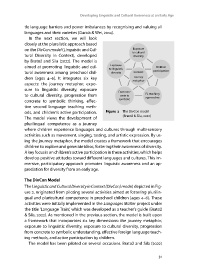
             by Bratož and Sila (2022). The model is
                                                      Exposure
             aimed at promoting linguistic and cul-                         Children
                                                     to linguistic
             tural awareness among preschool chil-    diversity  Context  participation
             dren (ages 4–6). It integrates six key              Journey
                                                                metaphor
             aspects: the journey metaphor, expo-
             sure to linguistic diversity, exposure
                                                          From con-    FL teaching
             to cultural diversity, progression from      crete to    approaches
                                                          symbolic
             concrete to symbolic thinking, effec-
             tive second language teaching meth-
             ods, and children’s active participation.  Figure 2 The DivCon model
                                                            (Bratož & Sila, 2022)
             The model views the development of
             plurilingual competence as a journey
             where children experience languages and cultures through multi-sensory
             activities such as movement, singing, tasting, and artistic expression. By us-
             ing the journey metaphor, the model creates a framework that encourages
             children to explore and generate ideas, fostering their awareness of diversity.
             A key focus is on children’s active participation in these activities, which helps
             develop positive attitudes toward different languages and cultures. This im-
             mersive, participatory approach promotes linguistic awareness and an ap-
             preciation for diversity from an early age.

             The DivCon Model
             The LinguisticandCulturalDiversityinContext(DivCon)model, depicted in Fig-
             ure 2, originated from piloting several activities aimed at fostering plurilin-
             gual and pluricultural competence in preschool children (ages 4–6). These
             activities were initially implemented in the Languages Matter project under
             the title ‘Language Train,’ which was developed as a teacher’s guide (Bratož
             & Sila, 2022). As mentioned in the previous section, the model is built upon
             a framework that incorporates six key dimensions: the journey metaphor,
             exposure to linguistic diversity, exposure to cultural diversity, progression
             from concrete to symbolic understanding, effective foreign language teach-
             ing methods, and active participation by children.
               The model has been piloted on several occasions. Bratož and Sila (2022)


                                                                             31

