


Page 18 - Dalle origini ai giorni nostri: convergenze e divergenze tra lingue slave
P. 18
Paola Bocale


                  respondent refuses to give his opinion about the general state of the ‘fa-
                  therland’, i.e. Russia, the interlocutor is expecting to receive.
                    Similarly, in example (3) ja ne znaju mitigates the illocutionary force of
                  the utterance and smoothes the conversational interaction by downgrad-
                  ing the statement to a supposition about the real amount of money in the
                  budget and who might have more than thought.
                  Epistemic hedge

                  The previous examples illustrate that ja ne znaju has several character-
                  istics that might not be captured if we were to consider this construc-
                  tion only as an epistemic stance-marker. In many contexts ja ne znaju is
                  used to moderate the force of an utterance or the certainty of its content
                  (Neary-Sundquist 2013), inviting the listener to attribute a more indefi-
                  nite meaning to the context it refers to. In this way it seems to function
                  pragmatically as a hedge (Aijmer 1984; Hyland 1998; Weatherall 2011),
                  given that it makes the context vague rather than specific and precise.
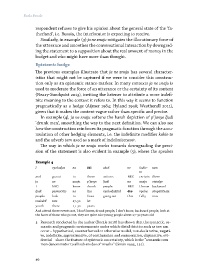
                    In example (4), ja ne znaju softens the harsh depiction of p’janye ljudi
                  ‘drunk men’, smoothing the way to the next definition. We can also see
                  how the construction reinforces its pragmatic function through the accu-
                  mulation of other hedging elements, i.e. the indefinite modifier kakie-to
                                                                 5
                  and the adverb tam used as a mark of indefiniteness .
                    The way in which ja ne znaju works towards downgrading the preci-
                  sion of the statement is also evident in example (5), where the speaker


                  Example 4
                  I       vychodjat  na    èti    akcii       ne    kakie-  tam
                                                                    to
                  and     go.out    to     these  actions     NEG   certain there
                  ja      ne        znaju  p’janye  ljudi     ne    znaju  otstalye
                  I       NEG       know   drunk  people      NEG   I.know backward
                  ljudi   posmotrite  na   lica   vychodjaščich  èto  vpolne  simpatičnaja
                  people  look      to     faces  going.out   this  fully  nice
                  molodež’  tam     27-30  let
                  youth   there     27-30  years
                  And attend these events not, I don’t know, drunk people, I don’t know, backward people, look at
                  the faces of those who go out, they are quite nice young people about 27-30 years old
                  5  Research conducted by the author (Bocale 2018) has shown that the syntactic, se-
                    mantic and pragmatic environments under which distal deictics such as tam can
                    occur – hypothetical, counterfactual or otherwise modal, non-declarative, negati-
                    ve, indefinite, approximative, of continuation and enumeration, disjunctive, evi-
                    dential – share the feature of epistemic uncertainty, which is the “semantic com-
                    mon denominator to all sub-modes of irrealis” (Givón 1995, 121).


                  16

