


Page 40 - Educational Leadership in a Changing World
P. 40
Rasa Nedzinskait˙ e-Mači¯ unien˙ e and Antonios Kafa

                school leaders being particularly important. However, contextual fac-
                tors such as the level of autonomy in school organizations, whether cen-
                tralized or decentralized, along with the economic, social, and cultural
                status of students, can shape the role of school leaders. Instructional
                leadership enhances student learning primarily through teacher de-
                velopment and curriculum management rather than directly affecting
                student performance. Similarly, the impact of school autonomy on stu-
                dent achievement varies depending on school leadership capacity, ac-
                countability structures, and socioeconomic conditions. The economic,
                social, and cultural status of students plays a crucial role in moderating
                and mediating these relationships, underscoring the need for context-
                sensitive leadership approaches.
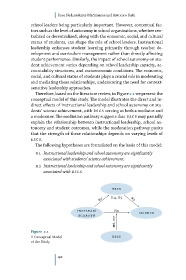
                  Therefore, based on the literature review, in Figure 2.1 we present the
                conceptual model of this study. The model illustrates the direct and in-
                direct effects of instructional leadership and school autonomy on stu-
                dents’ science achievement, with escs serving as both a mediator and
                a moderator. The mediation pathway suggests that escs may partially
                explain the relationship between instructional leadership, school au-
                tonomy and student outcomes, while the moderation pathway posits
                that the strength of these relationships depends on varying levels of
                escs.
                  The following hypotheses are formulated on the basis of this model:

                  h1 Instructional leadership and school autonomy are significantly
                      associated with students’ science achievement.
                  h2 Instructional leadership and school autonomy are significantly
                      associated with escs.


                                                      escs

                                                h2    h4, h5   h3


                                      instlead/        h1          science
                                      schauto
                                                        h7
                                                        h6,
                Figure 2.1
                AConceptualModel                      escs
                of the Study


                            40

