


Page 100 - Safe Wrestling
P. 100
Rok Vatovec, Marina Dobnik, and Matej Plevnik

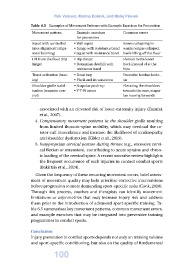
                Table 6.5 Examples of Movement Patterns with Example Exercises for Prevention
                Movement pattern     Example exercises      Common errors
                                     for prevention
                Squat with controlled  • Wall squat         Knees collapsing in-
                knee alignment (align-  • Lunge with resistance band  wards (valgus collapse),
                ment learning)      • Squat with resistance band  heels lifting off the floor
                Lift from the floor (hip  •Hip thrust        Flexioninthe lower
                hinge)              • Romanian deadlift with  back instead of at the
                                     resistance band        hips
                Trunk activation (brac-  •Dead bug          Excessive lumbar lordo-
                ing)                • Plank and its variations  sis
                Shoulder girdle stabil-  • Scapular push-up  Elevating the shoulders
                isation (scapular con-  • Y-T-W raises      towards the ears, scapu-
                trol)                                       lae moving forwards


                    associated with an elevated risk of lower-extremity injury (Zazulak
                    et al., 2007).
                  4. Compensatory movement patterns in the shoulder girdle resulting
                    from limited thoracic-spine mobility, which may overload the ro-
                    tator cuff musculature and increase the likelihood of tendinopathy
                    and shoulder dysfunction (Kibler et al., 2013).
                  5. Inappropriate cervical posture during throws (e.g., excessive cervi-
                    cal flexion or extension), contributing to acute sprains and chron-
                    ic loading of the cervical spine. A recent narrative review highlights
                    the frequent occurrence of such injuries in contact combat sports
                    (Bakirtzis et al., 2024).
                  Given the frequency of these recurring movement errors, brief assess-
                ment of movement quality may help prioritise corrective interventions
                before progression to more demanding sport-specific tasks (Cook, 2010).
                Through this process, coaches and therapists can identify movement
                limitations or asymmetries that may increase injury risk and address
                them prior to the introduction of advanced sport-specific training. Ta-
                ble 6.5 summarises key movement patterns, common movement errors,
                and example exercises that may be integrated into preventive training
                programmes in combat sports.

                Conclusion
                Injury prevention in combat sports depends not only on training volume
                and sport-specific conditioning, but also on the quality of fundamental

                           100

