


Page 149 - Sustaining Accommodation SMES
P. 149
8 Implications for Policy and Practice
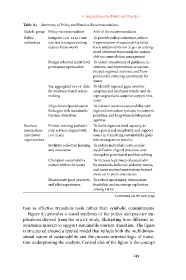
Table 8.1 Summary of Policy and Practice Recommendations
Stakeh. group Policy recommendation Aim of the recommendation
Public Integrate iso into To provide policy coherence, reduce
authorities tourism strategies and reg- fragmentation of sustainability initia-
ulatory frameworks tives, and position iso as a recog-
nised reference framework for sustain-
able accommodation management
Design coherent multi-level To ensure consistency of guidance, in-
governance approaches centives, and expectations across mu-
nicipal, regional, national, and Euro-
pean levels, reducing uncertainty for
smes
Use aggregated mast data To identify regional gaps, monitor
for evidence-based policy- adoption and readiness trends, and de-
making sign targeted and adaptive support mea-
sures
Align Smart Specialisation To connect tourism sustainability with
Strategies with sustainable regional innovation systems, investment
tourism objectives priorities, and long-term development
agendas
Business Provide training and advi- To build organisational capacity, re-
associations sory services aligned with duce perceived complexity, and support
and cluster iso smes in translating sustainability goals
organisations into management practice
Facilitate collective learning To reduce individual costs, acceler-
and innovation ate diffusion of good practices, and
strengthen peer-based problem solving
Champion sustainability To increase legitimacy of sustainabil-
culture within the sector ity standards, influence industry norms,
and move sectoral expectations beyond
short-term profit orientation
Disseminate good practices To reduce uncertainty, demonstrate
and pilot experiences feasibility, and encourage replication
among smes
Continued on the next page
tion as effective transition tools rather than symbolic commitments.
Figure 8.1 provides a visual synthesis of the policy and practice im-
plications derived from the mast study, illustrating how different in-
struments interact to support sustainable tourism transition. The figure
is structured around a layered model that reflects both the multidimen-
sional nature of sustainability and the process-oriented logic of transi-
tion underpinning the analysis. Central idea of the figure is the concept
149

