


Page 49 - Diversity in Action
P. 49
Transfer in Early Multilingual Acquisition


                • transfer from the L1 is only partial, meaning that the initial stage of L2
                  learning does not coincide with the final L1 stage;
                • learners can transfer a structure from their L1 only when they are devel-
                  opmentally ready to produce it.

               Håkansson et al. (2002) have proved this hypothesis by conducting a cross-
             sectional study on 20 Swedish L1 learners studying English L2 and focusing
             on the acquisition of the verb-second (V2) structure. As anticipated in the
             section ‘Which factors lead speakers to transfer?,’ this structure is present in
             both Swedish and German. In both languages, the fronting of adverbials for
             discourse and pragmatic reasons entails that the subject comes immediately
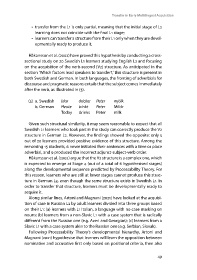
             after the verb, as illustrated in (5).


               (5) a. Swedish  Idar    dricker  Peter  mjölk
                  b. German   Heute    trinkt  Peter   Milch
                              Today    drinks  Peter   milk

               Given such structural similarity, it may seem reasonable to expect that all
             Swedish L1 learners who took part in the study can correctly produce the V2
             structure in German L2. However, the findings showed the opposite: only 5
             out of 20 learners provided positive evidence of this structure. Among the
             remaining 15 students, 6 never initiated their sentences with a time or place
             adverbial, and 9 produced the incorrect adjunct-subject-verb order.
               Håkansson et al. (2002) argue that the V2 structure is a complex one, which
             is expected to emerge at Stage 4 (out of a total of 6 hypothesised stages)
             along the developmental sequence predicted by Processability Theory. For
             this reason, learners who are still at lower stages cannot produce this struc-
             ture in German L2, even though the same structure exists in Swedish L1. In
             order to transfer that structure, learners must be developmentally ready to
             acquire it.
               Along similar lines, Artoni and Magnani (2021) have looked at the acquisi-
             tion of case in Russian L2 by adult learners divided into three groups based
             on their L1: (a) learners with L1 Italian, a language with no case marking on
             nouns; (b) learners from a non-Slavic L1 with a case system that is radically
             different from the Russian one (e.g. Azeri and Georgian); (c) learners from a
             Slavic L1 with a case system akin to the Russian one (e.g. Serbian, Slovak).
               Following Processability Theory’s developmental hierarchy, Artoni and
             Magnani (2021) hypothesise that learners will learn the opposition between
             nominative and accusative first only based on positional criteria, then also


                                                                            49

