


Page 110 - Diversity in Action
P. 110
Natascha J. Taslimi, Ursula Maurič, and Karin Steiner


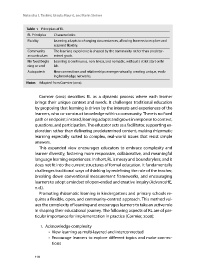
              Table 1 Principles of RL
              RL Principles  Characteristics
              Fluidity     Learning adapts to changing circumstances, allowing learners to explore and
                           respond flexibly.
              Community    The learning experience is shaped by the community rather than predeter-
              as curriculum  mined goals.
              No fixed begin-  Learning is continuous, non-linear, and nomadic, without a strict start or fin-
              ning or end  ish.
              Autopoiesis  New connections and relationships emerge naturally, creating unique, evolv-
                           ing knowledge networks.
              Notes Adapted from Cormier (2012).


                    Cormier (2012) describes RL as a dynamic process where each learner
                  brings their unique context and needs. It challenges traditional education
                  by proposing that learning is driven by the interests and experiences of the
                  learners, who co-construct knowledge within a community. There is no fixed
                  path or endpoint; instead, learning adapts and grows in response to context,
                  questions, and participation. The educator acts as a facilitator, supporting ex-
                  ploration rather than delivering predetermined content, making rhizomatic
                  learning especially suited to complex, real-world issues that resist simple
                  answers.
                    This expanded view encourages educators to embrace complexity and
                  learner diversity, fostering more responsive, collaborative, and meaningful
                  language learning experiences. In short, RL is messy and boundaryless, and it
                  does not fit into the current structures of formal education. It fundamentally
                  challenges traditional ways of thinking by redefining the role of the teacher,
                  breaking down conventional measurement frameworks, and encouraging
                  learners to adopt a mindset of open-ended and creative inquiry (AdvanceHE,
                  n.d.).
                    Promoting rhizomatic learning in kindergartens and primary schools re-
                  quires a flexible, open, and community-centred approach. This method val-
                  ues the complexity of learning and encourages learners to take an active role
                  in shaping their educational journey. The following aspects of RL are of par-
                  ticular importance for implementation in practice (Cormier, 2008):

                     1. Acknowledge complexity
                        • View learning as multi-layered and interconnected
                        • Encourage learners to explore different topics and make connec-
                          tions


                  110

