


Page 115 - Educational Leadership in a Changing World
P. 115
Navigating between Principalship, Leadership and Management


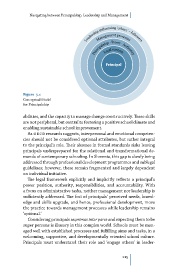
                                               Management processes
                                          Leadership influencing ‘others’ – followers
                                                   Legal context
                                              Principalship · Power · Authority

                                                   Principal


            Figure 5.1
            Conceptual Model
            for Principalship


            abilities, and the capacity to manage change constructively. These skills
            are not peripheral, but central to fostering a positive school climate and
            enabling sustainable school improvement.
              As oecd research suggests, interpersonal and emotional competen-
            cies should not be considered optional attributes, but rather integral
            to the principal’s role. Their absence in formal standards risks leaving
            principals underprepared for the relational and transformational de-
            mands of contemporary schooling. In Slovenia, this gap is slowly being
            addressed through professional development programmes and sublegal
            guidelines; however, these remain fragmented and largely dependent
            on individual initiative.
              The legal framework explicitly and implicitly reflects a principal’s
            power position, authority, responsibilities, and accountability. With
            a focus on administrative tasks, neither management nor leadership is
            sufficiently addressed. The foci of principals’ perceived needs, knowl-
            edge and skills upgrade, and hence, professional development, move
            the practice towards management processes while leadership remains
            ‘optional.’
              Considering principals as primus inter pares and expecting them to be
            super persons is illusory in this complex world. Schools must be man-
            aged well with established processes and fulfilling aims and tasks, in a
            welcoming, supportive, and developmentally oriented school culture.
            Principals must understand their role and ‘engage others’ in leader-


                                                           115

