


Page 52 - Safe Wrestling
P. 52
Matej Ipavec

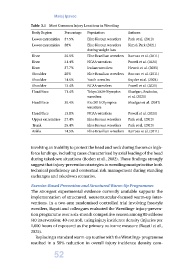
                Table 3.1 Most Common Injury Locations in Wrestling
                Body Region     Percentage  Population        Authors
                Lower extremities  37.5%   Elite Korean wrestlers  Park et al. (2019)
                Lower extremities  38%     Elite Korean wrestlers  Kim & Park (2021)
                                           during weight loss
                Knee            25.5%      Elite Brazilian wrestlers  Barroso et al. (2011)
                Knee            21.4%      NCAA wrestlers     Powell et al. (2021)
                Knee            37.7%      Indian wrestlers   Hewett et al. (2005)
                Shoulder        20%        Elite Brazilian wrestlers  Barroso et al. (2011)
                Shoulder        14.6%      Youth wrestles     Snyder et al. (2024)
                Shoulder        13.4%      NCAA wrestlers     Powell et al. (2021)
                Head/face       71.4%      Tokyo 2020 Olympics  Shadgan, Szabolcs,
                                           wrestlers          et al. (2021)
                Head/face       36.4%      Rio 2016 Olympics  Shadgan et al. (2017)
                                           wrestlers
                Head/face       13.8%      NCAA wrestlers     Powell et al. (2021)
                Upper extremities  27.4%   Elite Korean wrestlers  Park et al. (2019)
                Trunk           25.4%      Elite Korean wrestlers  Park et al. (2019)
                Ankle           14.5%      Elite Brazilian wrestlers  Barroso et al. (2011)


                involving an inability to protect the head and neck during throws or high-
                force landings, including cases characterised by axial loading of the head
                during takedown situations (Boden et al., 2002). These findings strongly
                suggest that injury-prevention strategies in wrestling must prioritise both
                technical proficiency and contextual risk management during standing
                exchanges and takedown scenarios.
                Exercise-Based Prevention and Structured Warm-Up Programmes
                The strongest experimental evidence currently available supports the
                implementation of structured, neuromuscular-focused warm-up inter-
                ventions. In a two-arm randomised controlled trial involving freestyle
                wrestlers, Bayati and colleagues evaluated the Wrestling+ injury-preven-
                tion programme over a six-month competitive season among 80 athletes
                (40 intervention; 40 control), using injury incidence density (injuries per
                1,000 hours of exposure) as the primary outcome measure (Bayati et al.,
                2025).
                  Replacing a standard warm-up routine with the Wrestling+ programme
                resulted in a 58% reduction in overall injury incidence density com-

                           52

