


Page 91 - Diversity in Action
P. 91
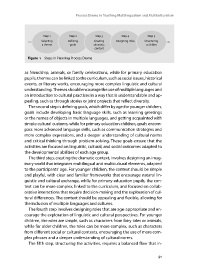
Process Drama in Teaching Multilingualism and Multiculturalism


                      Step 1      Step 2       Step 3      Step 4       Step 5
                     Selecting   Defining      Creating  Designing roles  Structuring
                     atheme       goals       dramatic                 activities
                                              context

              Figure 1 Steps in Planning Process Drama


             as friendship, animals, or family celebrations, while for primary education
             pupils,themescan belinkedto thecurriculum,such associalissues,historical
             events, or literary works, encouraging more complex linguistic and cultural
             understanding.Themesshouldencouragetheuseofmultiplelanguagesand
             an introduction to cultural practices in a way that is understandable and ap-
             pealing, such as through stories or joint projects that reflect diversity.
               Thesecondstepisdefininggoals,whichdifferbyage:foryoungerchildren,
             goals include developing basic language skills, such as learning greetings
             or the names of objects in multiple languages, and getting acquainted with
             simple cultural customs, while for primary education children, goals encom-
             pass more advanced language skills, such as communication strategies and
             more complex expressions, and a deeper understanding of cultural norms
             and critical thinking through problem-solving. These goals ensure that the
             activities are focused on linguistic, cultural, and social outcomes adapted to
             the developmental abilities of each age group.
               The third step, creating the dramatic context, involves designing an imag-
             inary world that integrates multilingual and multicultural elements, adapted
             to the participants’ age. For younger children, the context should be simple
             and playful, with clear and familiar frameworks that encourage natural lin-
             guistic and cultural exchange, while for primary education pupils, the con-
             text can be more complex, linked to the curriculum, and focused on collab-
             orative interactions that require decision-making and the exploration of cul-
             tural differences. The context should be appealing and flexible, allowing for
             the inclusion of multiple languages and cultures.
               The fourth step involves designing roles that are age-appropriate and en-
             courage the exploration of linguistic and cultural perspectives. For younger
             children, the roles are simple, such as characters from fairy tales or animals,
             while for older children, the roles can be more complex, such as characters
             from different social or cultural contexts, encouraging the use of more com-
             plex phrases and a deeper understanding of cultural norms.
               The fifth step, structuring the activities, requires a balanced flow that in-


                                                                             91

